Shouldn’t people have the power?
- Matt Orsagh, Arketa Institute

What is the capacity that Pensions & Endowments derive from their capacity as large, programmatic and self-perpetuating “forever machines’, under the circumstnaces now prevailing?

The current rules push people out, and put experts in charge.
But is the expertise that these experts are expert in really the expertise we need to power our “forrver machines”, forever?
This is the question that drives me on this passion project, to change the rules of who has the power to decide the right way for pensions, mostly, but also endowments, for universities and foundations, to allocate the aggregations of society’s “safe” money that we entrust to their plenary powers of discretionary authority, within the constraints of prudence and loyalty, as capital for business to curate the technologies that curate the choices that curation the economy that curates society that curates the future, as our true frontier.
The current rules gives that power to securities trading markets professionals.
The new rules give that power to us!
Hello, and welcome!
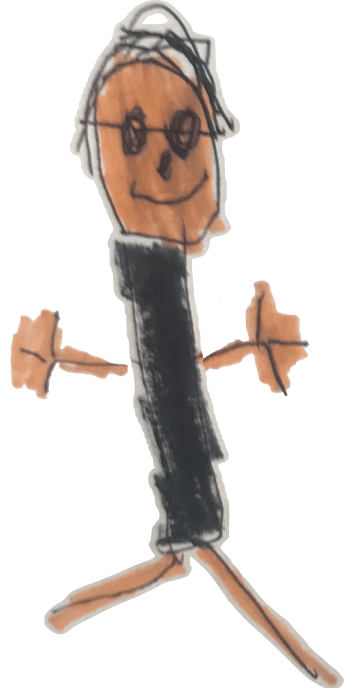
I am Tim MacDonald.
<— This is a portrait of me drawn by my granddaughter, Ellie, when she was 4 year old.
I am a philospher by education and a lawyer by profession, with specialized expertise in US partnership income tax and transactions law.
I learned about Money and Finance and Enterprise and the Economy from the perspective of the United States Internal Revenue Code.
That perspecitive shows something very different from what you see when you look at the economy from the perspective of what we now called, in common parlance, variously, the Capital Markets, the Financial Markets, the Markets and the Financia System.
One of the things I learned to see over the course of my career in law, finance, the regulation of finance and the taxation of enterprise is that pensions are the most powerful social force in the world today. They operate at planetary scale. They operate within planetary scale responsibilities.
Bsuiness, banking, insurance and securiteis trading also operate at planetary scales.
But none of them have legally enforceable responsibilities for the quality of life that people live, on earth.
Pensions do.
They have these responsibilities because they are constituted as large, programmatic and self-perpetuating social trusts. They are, in the words of Peter Ellis, “other than privately self-interested capital”. They are capital that is interested, by law, in perpetuating their purposes, which is to povision the promise of income security in a dignified retirement to so many, directly, as a private benefit, that is also, of necessity, a promise of a secure and dignified future for us all, as a public good.
Capital is, as Peter Ellis also tells us, “just savings”. Savings are money set aside for a future purpose, for a future time. The savings aggregated into pension trusts are for the future time of retirement. They are for the future purpose of a dignified quallity of life in retirement.
They are for the future.
They are for a dignified quality of life in the future.
They are for so many, directly, that they are for us all, consequently.
The are for our shared, social future quality of life.
We, the people, power pensions in their purpose of our future quality of life.
Some, directly, as contracted participants. Others, indirectly, as citizens and taxpayers who enable those contracts, and subsidize that participation. Through our taxes.
We, the people, have the power to enforce the responsibility of pensions to the dignity of our shared future, because the law:
- requires prudence in the exercise of the capacity that pension trusts derive from their legally constituted character, as large, programmatic and self-perpetuating “forever machines”, in undivided loualt totheir contractually specified aims, to make contractually calculated pauments to contractually qualifed recipients at contractually specified intervals, across a self-perpetuating population of contractually qualifying recipients;
- according to our common sense, as prudent people who care enough to take the time to make the effort to make ourselves familiar with such matters, or their capacity, prudence and loyalty, under the circumstnces then prevaling, as those circumstances, and that capacity, prudence and loyalty, change, adapt and evolve, from time to time, and over time.
We gave that power away, to Wall Street, beginning in the 1970s.
We have learned, since then, that was a mistake.
It is time now for us to correct that mistake, and take that power back, to ourselves.
Getting you to join me in taking tht power back is my passio project.
My life’s work.
My calling.
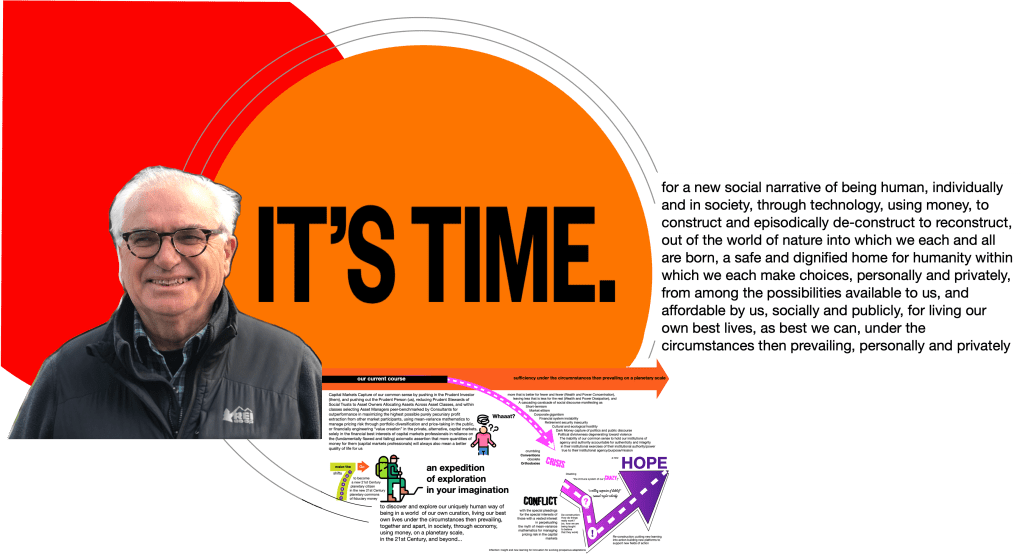
I am the publisher, producer, editor and composer of this digital experience, as a passion project to show you what I have learned to see, as my way of inviting you to join with me in promoting a new set of rules for how the people can, should and will take back the power of our pensions, as “other than privately self-interested capital” financing “non-shareholder purposed entities” to attach “rights and needs of the general population, of consumers and wider society,… to
the economy” (Peter Ellis).


Leave a Reply