I am the composer, editor, producer and publisher of this digital experience for radically rethinking our social narrative of being human in the world.
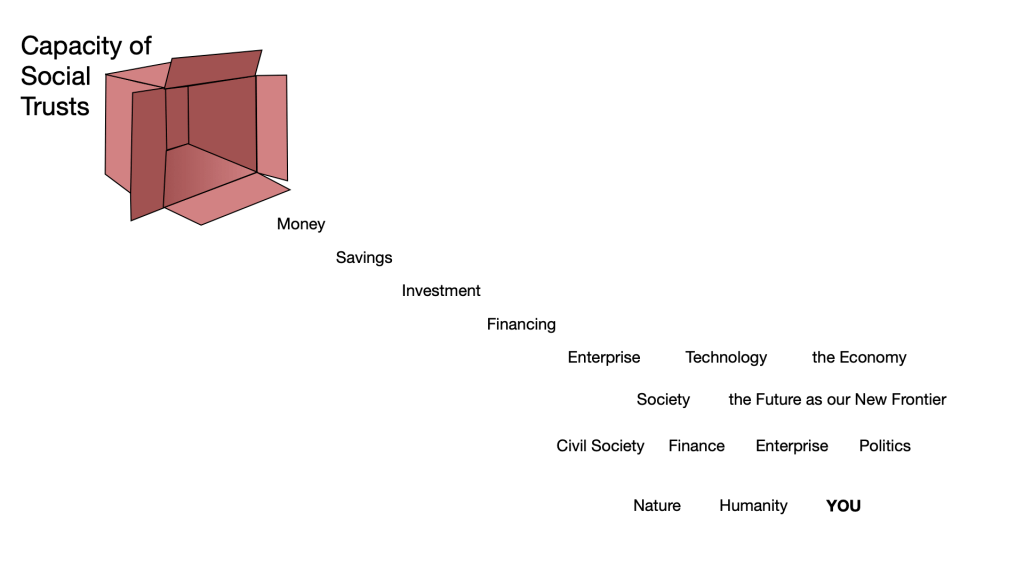
This is part of my passion project, to show you what I have learned to see, about Money and Savings and Investment and Financing and Business and Technology and the Economy and Society and the Future as our True Frontier, and Civil Society and Finance and Enterprise and Politics and Nature and Humanity and You, we and each and all of us, as inidividuals.
It is my way of inviting you to join with me in promoting a new set of rules for how we, the people, can, should and will take back the power of our pensions, as “other than privately self-interested capital” to finance “non-shareholder purposed entities” in attaching “therights and needs of the general population, of consumers and wider society,… to the economy” (Peter Ellis).
I come to this work by way of personal family tragedy.
My dad worked as a firefighter for the City of Fall River, in the Commonwealth of Massachusetts, USA. (Serendipitously, Fall River is an old textile manufacturing center that is home to the Bourne Mills that were part of the Berkshire-Hathaway textile conglomerate that gave its name to Warren Buffet’s publicly owned private equity firm).
My dad died of work related causes at a young age, leaving my mother widowed with six minor children. This personal family tragedy could have become a family financial catastrophe of Victorian proportions.
Except that my father belonged to a union.
And that union was party to a collective bargaining agreement.
And that collective bargaining agreement included, among other things, the promise of a pension in retirement.
And that promise included survivor benefits.
So my mom inherited my father’s pension on his death, giving our family the comfort of financial security in this time of personal tragedy.
So I feel, at a very personal level, the power of pensions as a social good, and believe very strongly that society can and should support the pension promise as a cohesive force in an equitable society.
In my own personal journey, I went on to become a philospher by education and a lawyer by profession, with specialized expertise in US partnership income tax and transactions law.
I learned about Money and Finance and Enterprise and the Economy by looking at them through the lens of the United States Internal Revenue Code.
That view showed me something very different from what you see when you look at the economy through the lens of what we now call, in common parlance, variously, the Capital Markets, the Financial Markets, the Markets or (together with Banks, and maybe also Insurance, and perhaps also Philanthropy [but what is the role of Government?, and what about Family Offices? and where, actually, do Pensions, and retirement savings, more generally, fit in?]) the Financial System.
One of the things I learned to see over the course of my career in law, transactions, the regulation of business and business finance, and the taxation of enterprise, is that pensions are the most powerful social force in the world today.
pensions are the most powerful social force in the world today
Tim MacDonald
Pensions (together with their smaller cousins, Endowments, for universities, foundations and other civil society institutions) operate at planetary scale.
And they operate with planetary responsibilities.
Business, banking, insurance and securities trading also operate at planetary scales.
But none of them have legally enforceable responsibilities for the quality of life that people live, on earth.
Pensions do.
ONLY pensions do.
Pensions have these responsibilities because they are constituted as large, programmatic and self-perpetuating social trusts.
They are, in the words of The Accidental Societist, Peter Ellis, “other than privately self-interested capital”.
They are capital that is interested, by law, in their own being and wellbeing, for the purpose of perpetuating their purposes, which are to povision the promise of income security in a dignified retirement to so many, directly, as a private benefit, that it is also, of necessity, a promise of a secure and dignified future for us all, consequently, as a public good.
Capital is, as Peter Ellis also tells us, “just savings”.
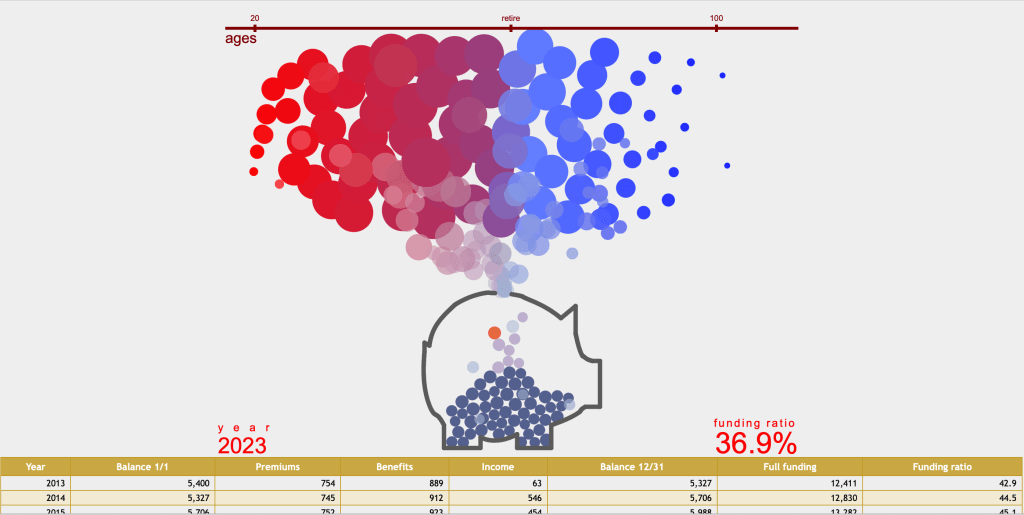
Savings is money set aside for a future purpose, for a future time. The money set aside through pension trusts is for the future time of retirement. It is for the future purpose of a dignified quallity of life in retirement.
It is for the future.
It is for a dignified quality of life in the future.
It is for so many, directly, that it is also for us all, consequently.
It is for our shared, social future quality of life.
We, the people, power pensions in their purpose, of our future quality of life.
Some, directly, as contracted participants.
Others, indirectly, as citizens and taxpayers who enable those contracts, and subsidize that participation.
Through our laws.
And our taxes.
We, the people, have the power to enforce the responsibility of pensions to the dignity of our shared future, because the law:
requires prudence in the exercise of the capacity that pension trusts derive from their legally constituted character, as large, programmatic and self-perpetuating “forever machines”, in undivided loyalty to their contractually specified aims, to make contractually calculated payments to contractually qualifed recipients at contractually specified intervals, across a self-perpetuating population of contractually qualifying recipients;
according to our common sense, as prudent people who care enough to take the time to make the effort to make ourselves familiar with such matters, of their capacity, prudence and loyalty, under the circumstances then prevaling, as those circumstances, and that capacity, prudence and loyalty, change, adapt and evolve, from time to time, and over time.
We gave that power away, to Wall Street, beginning in the 1970s.
We have learned, since then, that was a mistake.
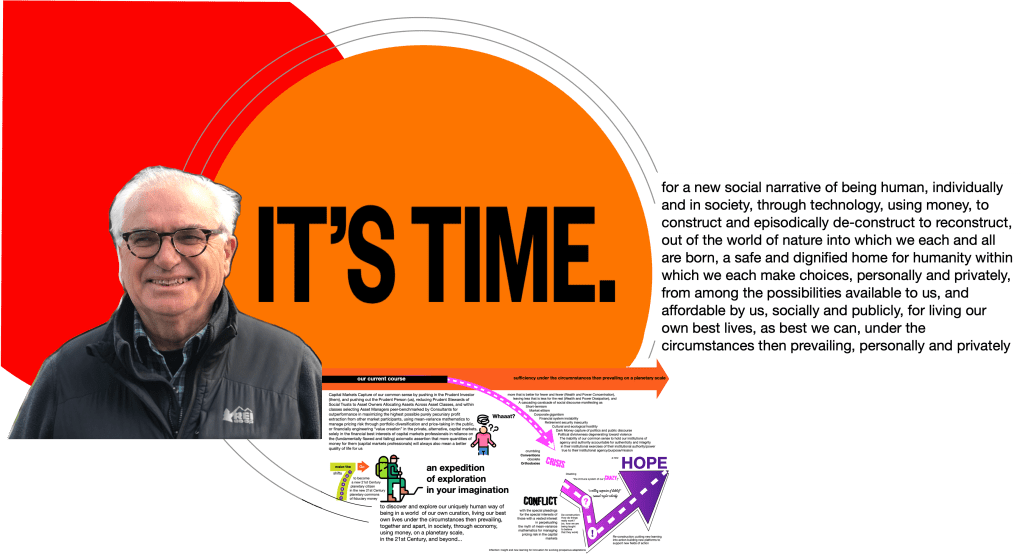
It is time now for us to correct that mistake, and take that power back, to ourselves.
 by talking about the crises,


