Lost.
Trapped in an obsolete, incomplete and fundamentally flawed and failing social narrative of being human in a world of Growth, as a 20th Century corruption of a 19th Century social narrative of Progress into an infinitely receding geobiophysical Frontier, through technological innovation and economies of scale.

This narrative took root in the early part of the 19th Century, within an experience that Nature is vast, and we are not, so we could just take and take and take from Nature, without ever caring for the consequences of our taking, because those consequences would just disappear into the Frontier, reabsorbed back into Nature, without consequence. To us.
It ended at the fin de siecle, during the Gilded Age, as humanity became, for the first time in our time upon this Earth, truly planetary, and there were no more frontiers; no more “strange new worlds”; no more “new life and new civilizations”. Everywhere on earth that we went, somebody was already there.
Our first response was industrialized warfare on a planetary scale, punctuated by a Great Depression and a New Deal that became a New International Order defined by a Cold War that became an Arms Race that became a Space Race, a race that was won by the United States at 10:58 pm Eastern Daylight Time on July 20, 1969, when American Astronaut Neil Armstrong, Mission Commander of the Apollo 11 Moon Mission stepped out of the lunar lander Eagle, taking his historic:
One small step for a man. One giant leap for Mankind.
But the step Neil took was not the leap we were expecting.
Humanity traveled to the moon expecting to find a New Frontier for renewed geobiophysical expansion through new technological innovation and ever-larger economies of scale.
When we got there, all we found was rocks.
And this New Reality: we have the earth, and it is well and truly ours; also, it is what we have.
Will it be enough?
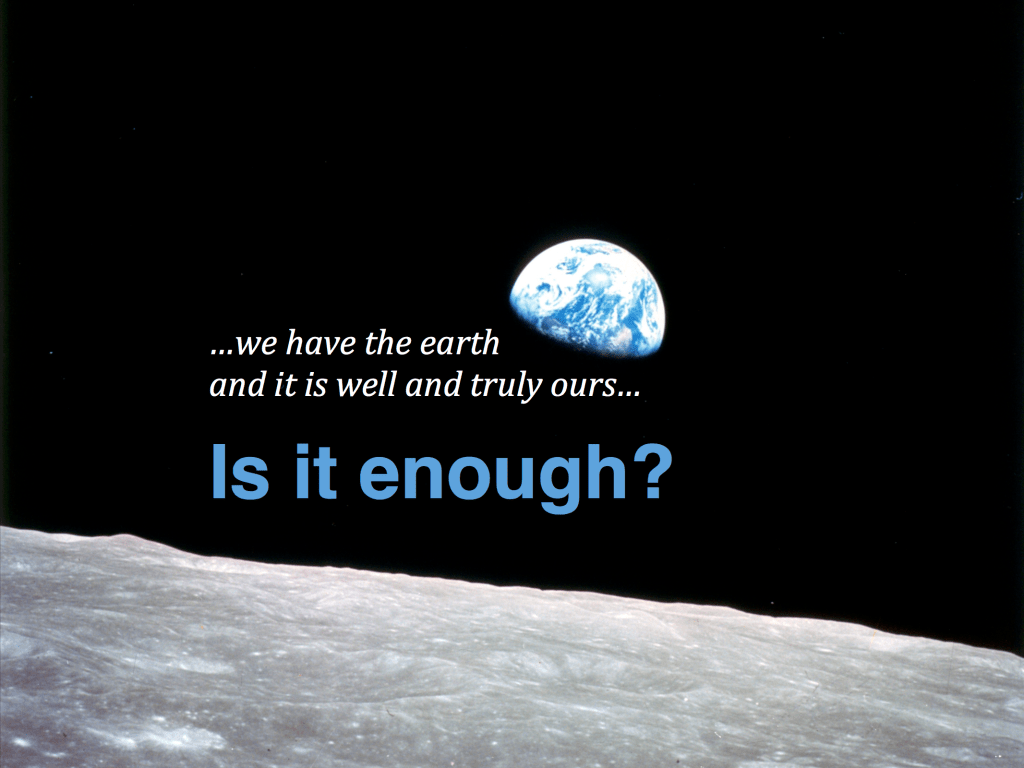
We are still struggling with this new reality of being human on a planetary scale, and within planetary limits.
Some refuse to accept those limits, choosing instead to believe that our future lies in Space, colonizing and terraforming Mars and then hopscotching our way from new planet to new planet expanding out into the infinite vastness of an infinitely expanding Universe.
Most just don’t think about it, choosing instead to believe that we can just reduce Progress to Growth, as the simple, numerical increase in transaction volumes measured in prices paid in money, from one period of measurement to the next.
But there is only one place in all of our human experience where this reduction of physical quality of life to numerical quantities of money holds true.
And that is the capital markets.
These markets are a place of prices, where everything is reduced to numbers, and these numbers must grow for the markets to deliver liquidity to market participants – buyers will buy, so that sellers can sell – that market participants require of the markets as the sine quo non of their participation: without growth, there is no liquidity in the markets; without liquidity, there are no participants in the markets; without participants, there are no markets, and no possibilities for market professionals to make money making markets.
This functional truth about the capital markets became the kernel of truth at the core of a whole lot of nonsense that became the new social narrative of Growth, as a special pleading for the special interests of capital markets professionals in making the capital markets the engine of our prosperity, and the new driver of our new human history.
This brings us to where we are today, heirs in these opening decades of the 21st Century, to a social narrative passed onto us from the closing decades of the 20th Century, that is incomplete, obsolete, fundamentally flaws and failing to deliver choices, and the ability to chose, within our truly planetary population that are right for our times, and fit to the circumstances in which we are now living.
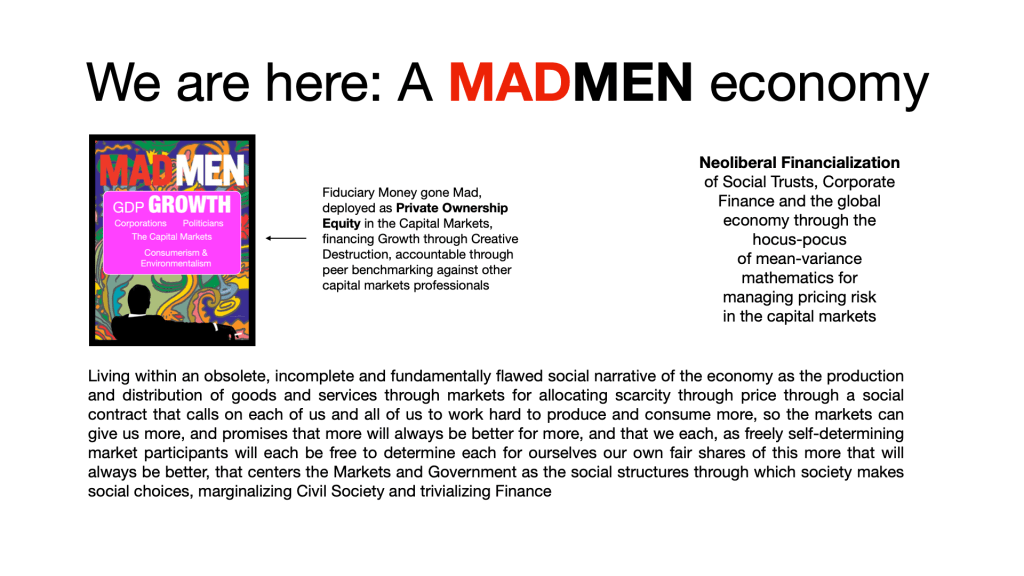
The problem is money.
And the primacy of the capital markets at the core of a Myth of Growth, built upon the axiomatic assertion of the false equivalency of more (for them) = better (for all).
The solution is also money.
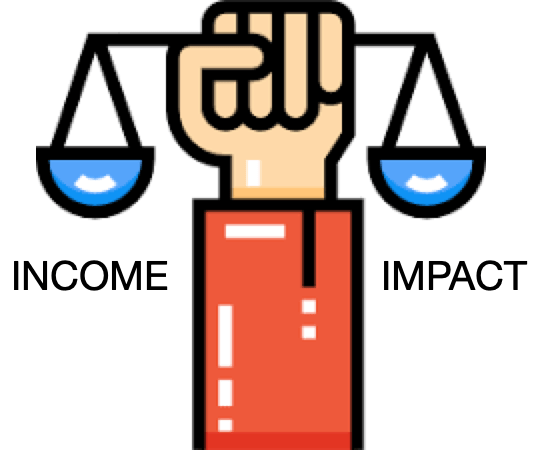
And a new social narrative of being human in society, through economy, using money on a planetary scale in the 21st Century, that rejects the false equivalency of more = better, and the primacy of the capital markets with their insatiable appetite for growth, with a new story about the existential connections between quantities of money and quality of life that need to be balanced for social cohesion ongoing into a dignified future.

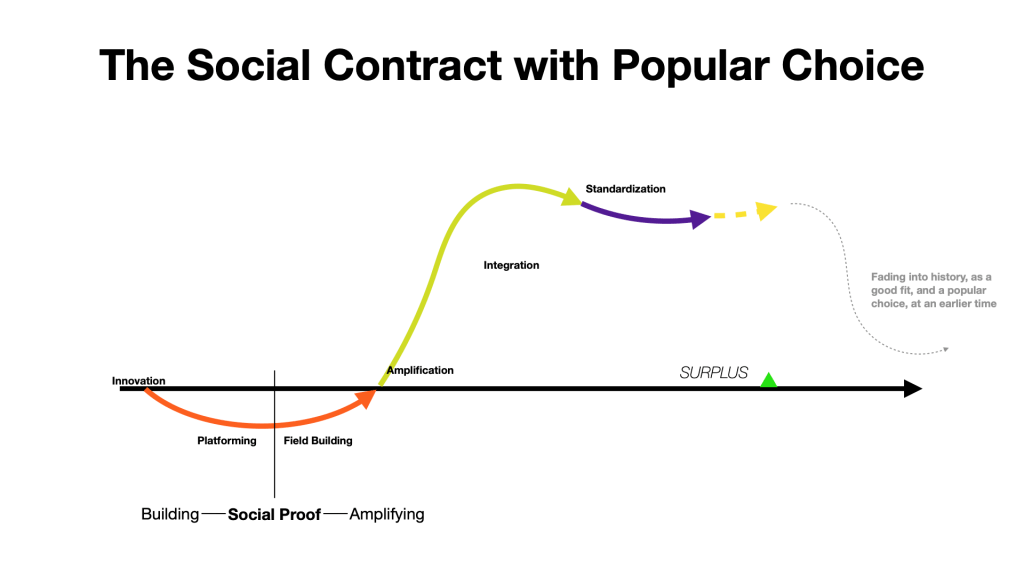

 Shifting to Equity Paybacks