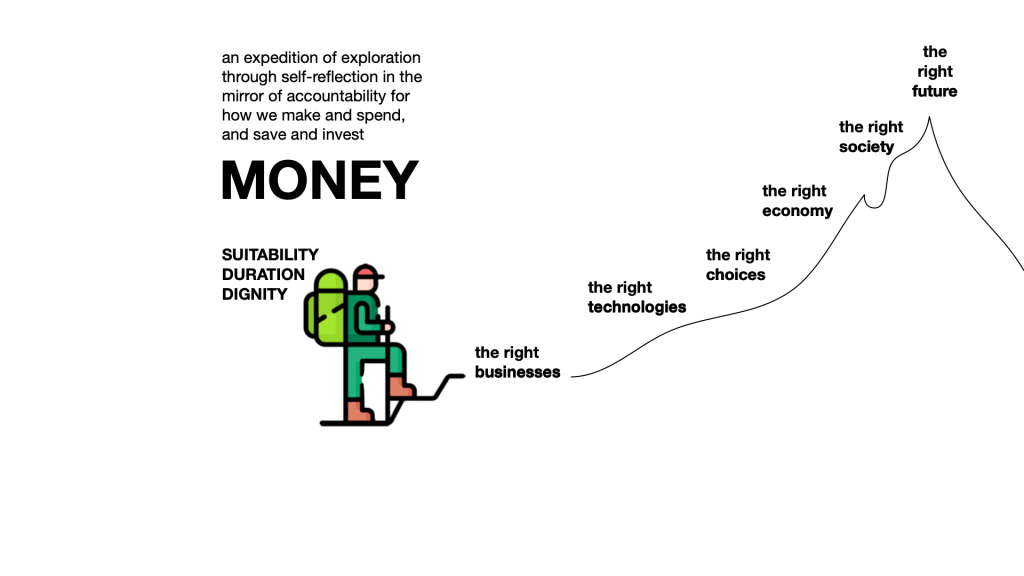
A new story of being human, in society, through economy, sharing an abundance of unique artifacts of technology, through exchange, using money, and the law, on a planetary scale, within planetary limits, in the 21st Century, and beyond…
The Prevailing Popular Story
We start with where we are, today.
That is, shackled to a locked imaginary that Growth is the highest and best expression of our human way of being in the world.
In this story of Growth as the Highest Human Virtue, we are each and all required to work hard to produce and consume more, so the economy of Firms and Households exchanging labor and capital for goods and services, in markets for allocating scarcity using price, can give us more.
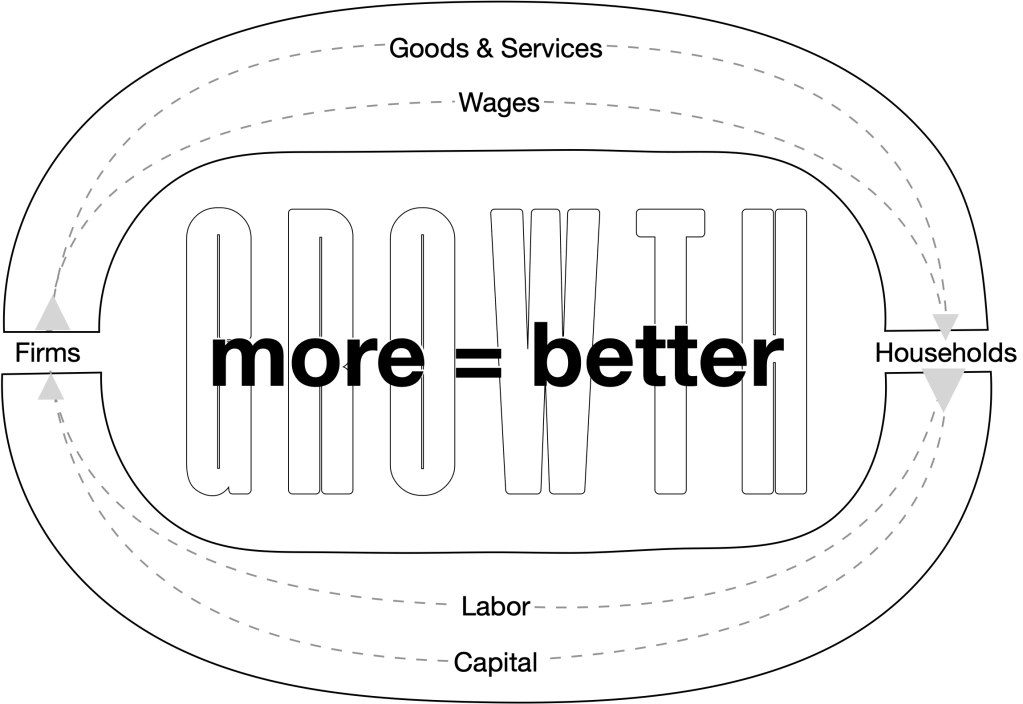
This requirement that we all must work hard to produce and consume more in premised on the promise that:
- more, quantitatively, will always also be better, qualitatively; and
- we each, as freely self-determining participants in this Economy, will always be free to each determine, each for ourselves, freely our own fair share of that more, quantitatively, that is always, also, better, qualitatively.
I have a lot of problems with this story, beginning with this false promise, on which the whole house of cards is built, that we are each free to determine for ourselves our own lot in life.
This is NOT true. Mostly.
It is a myth.
And like all myths, it contains a kernel of truth that gets wrapped up in a whole lot of nonsense.
The kernel of truth in this prevailing popular myth of perfect personal self-determination is this.
We do each have some freedom to make choices for ourselves.
In the markets for choosing stuff, we each do make choices for ourselves, personally and privately, based on our own personal and private judgements of:
- fitness for our own personal and private purposes, and
- price for performance, compared to other competing choices that we also could make, and other stuff we also want to spend our money to acquire.
But our freedom to choose based on self-determinations of fitness and price is constrained by the facts of:
- what is available for us, from which we can choose, and
- whether or not we actually have the power to make that choice, by paying the associated price.
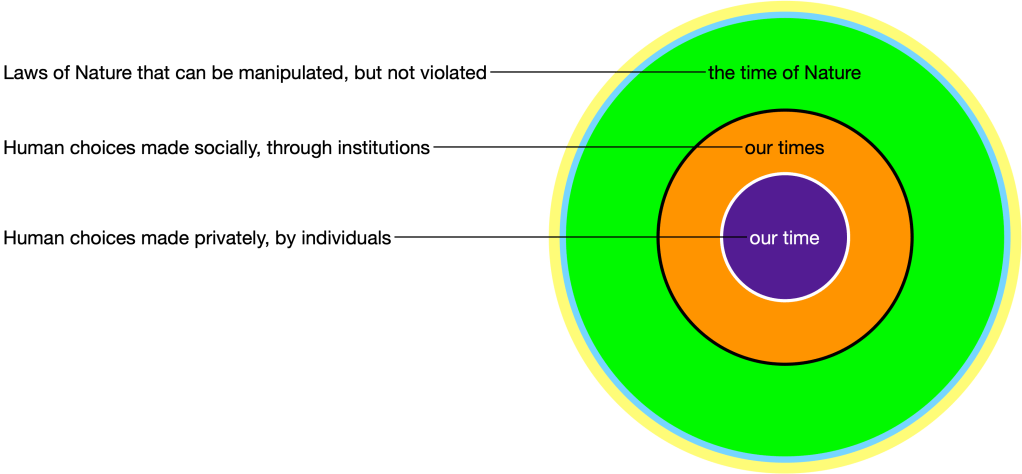
These constraints, of availability and ability to pay, are in some ways determined by us, for ourselves, in how we choose to live our own lives: what we choose to learn, how we choose to earn, what we choose to spend and how much we choose to save.
But mostly they are determined for us, by small numbers of people exercising with the power institutions of social choosing – through which society makes social choices, socially – that largely determine what choices will be made available to who, and what ability each of us will enjoy, to make those choices.
These institutions are everywhere in our human lives.
We can see them in the architecture of the environments we build for ourselves, in which we live, out of the world of Nature into which we each and all are born.
The include:
| Civil Society | Money | Enterprise | Politics |
| schools hospitals libraries churches museums universities theatres stadiums parks trails conservation lands | family savings churches and foundations taxing and spending banking insurance securities trading markets pensions and endowments | retail outlets (shops, stores, stalls and malls) warehouses distribution centers manufacturing facilities transportation links communication linkes administrative centers (office towers) | town hall city hall halls of congress seats of government courts and judges police and prisons the dreaded Department of Motor Vehicles and other buildings that house government bureaucracies |
Draw a map of any city, town or village. In addition to homes where people live, there will always also be these buildings that house the institutions through which that population holds itself together, as a community, in society, through choices made by some, that apply to all.
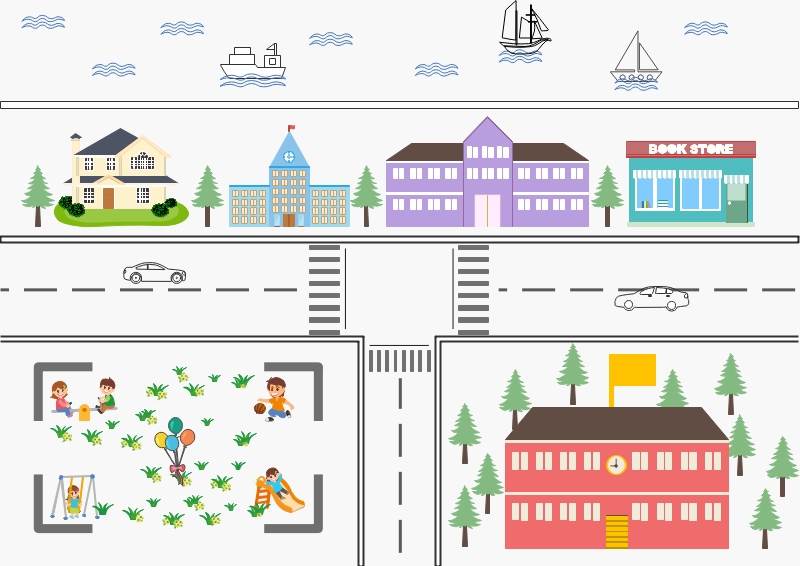
And yet, the prevailing popular narrative offers no explanation for most of these omnipresent buildings of ubiquitous human social belonging.
The rich complexity of human architecture – the buildings that house the activities of our daily lives, living together, in communities – is reduced to only two archetypes: Firms/Markets, and Households.
Everything else is pushed to the periphery, stripped of its humanity, and disparaged or discounted. As unimportant. Or oppressive.
Civil Society is dismissed, as “touchy feely”.
Money is trivialized, as a heartless, soulless utility.
Politics is demonized, as the enemy of freedom, of individuals and of firms (but mostly of firms, in the form of corporations, and of individuals exercising corporate power), to act in the markets however they choose; which is lionized as the one, true way to human happiness and wellbeing.
We are variously told that institutions don’t matter, and that the only institutions that do matter are Markets and Governments: private vs. public; price vs. policy; the individual vs. the shared; FREEDOM vs coercion.
And we are, truth be told, left confused by this. It makes no sense to our common sense.
The common sense of lived experience tells us that laws do not exist just to oppress business. They exist to keep the peace, and right the wrongs when bad actors act badly, causing people to get hurt.
- Politicians put up traffic lights, to minimize car crashes.
- Politicians provide sanitation services, so people don’t get sick.
- Politicians maintain parks, for kids to play in, dogs to walk in, and people to sit and have a cup of coffee, and collect our thoughts. Or just watch life go by. A moment of reprieve from the hustle and bustle of buying, and selling.
Consider, for example, these words, from the Preamble to the Constitution of the United States of America, listing the reasons why people form governments:
“in order to form a more perfect union, establish justice, insure domestic tranquility, provide for the common defense, promote the general welfare, and secure the blessings of liberty to ourselves and our posterity”
Nothing about oppressing business, or the individual.
Consider also this judgment of the new government formed as the United States of America by our first General and our first President, George Washington:
“The establishment of our new Government seemed to be the last great experiment for promoting human happiness”.
Politics in its highest and best – most authentically human – expression, is not about oppression, domination and subjugation.
It is about unity and equity, peace and security, wellbeing and continuity.
It is about human happiness.
Not inhumane belligerence
The tellers of this tale of Markets v. Governments, and of Money that doesn’t matter, also tell us, at the same time, the tale that money is THE measure of personal morality and worth as a person: those of us who have more money are, objectively, better, more morally upright, people (and those of us who have less are, conversely, and equally objectively, somehow less).
According to this story, it doesn’t matter HOW we get more money – whether we actually earn it “by the sweat of our brow”, conferring a great good on a great many people, the reward for which is control over a great deal of money; or we simply inherited, by accident of birth and the laws of inheritance; or we got it by immoral means.
Conversely, according to this story, those of us who have less, have less because we are less. Not because our institutions of social choosing are not choosing well, or fairly.
Just as, according to this story, the social structures that give more to many who have more do not matter, the social structures that give less to those who have less also do not matter.
It’s all down to us, and what each of us chooses to do, for ourselves.
This, to me, is nonsense.
It is a narrative conjured up by the privileged and entitled, in league with the devious and immoral, to put their claim of right to the social standing over others that they claim by virtue of the money they control – that they got by accident of birth, or by their bad actions as bad actors – beyond question and accountability, so that they can never be called to account for how it is that they came by their money, or why that money makes them better, and entitles them to rule over others.
I reject this narrative, that Money IS Morality, and a true and accurate measure of a person’s worth, the reward for merit and the punishment for being without merit.
Humanity is much more complicated than that.
Money is much more complicated than that.
And the narrative we really need, to live our own best lives, in pursuit of peace, and social belonging through social cohesion, is a narrative that makes us familiar with the true complexity of this uniquely human invention of this thing that does not exist in Nature, but is entirely of our own making: this thing we call:
MONEY
If we begin our story with this thing we call money, and pull on all the threads that weave us together, and hold us together, in community, as society, through economy using money, we get a much more complicated, much more human, story.
Of being human, in society, through economy.
A human-centered story.
That is powered by the uniquely human invention, of money.
There are few words in the English language that so completely express the roiling tumult of conflict and contentiousness that is our human way of being in the world as this one word, “money”.
By design, money is inert. A simple measure that in itself says nothing about the value of what is being measured. A purely factual recording of a quantity.
But what is being measured, what is being quantified by money, is our human relationships with each other; our worth, as a human, to another human. And that is very dangerous territory, this territory of our worth to others. It is a symphony of rationality and and a cacophony emotion, of thinking and feeling, of thoughtfulness and thoughtlessness, every single note of which is sounded in some way through money.
Money does not exist in Nature. It is completely made up, a purely human invention. A thing that is no thing. Nothing.
And yet it is the most powerful thing in the whole of human experience. The root of all evil. And the best revenge.
We all use money.
Some of us want it.
Some wish we did not have it.
We all need it.
Few really understand it.
Because our stories about money are as confused and conflicted as the relationships that we energize through money.
To have money is to have power over others. To be without money is to be without power, forced to become indentured to others, or driven to rely on our wiles in an effort to beguile.
To be sure, there is an empirical residue of human emotion that manifests without money: the care and caring of mother for child, of family and friends; the animosities of rivals and hatred of enemies.
But mostly, people live together using money.
Given the importance of money to our human way of being together in society, it seems we should have a universally accepted and clinically precise language and vocabulary for talking about money, much the way we have a language for talking about language. We know what words are and how they are used. When they are being used correctly, and when they are being corrupted.
But we don’t know so much about money.
Why not?
Let’s explore, to find out!