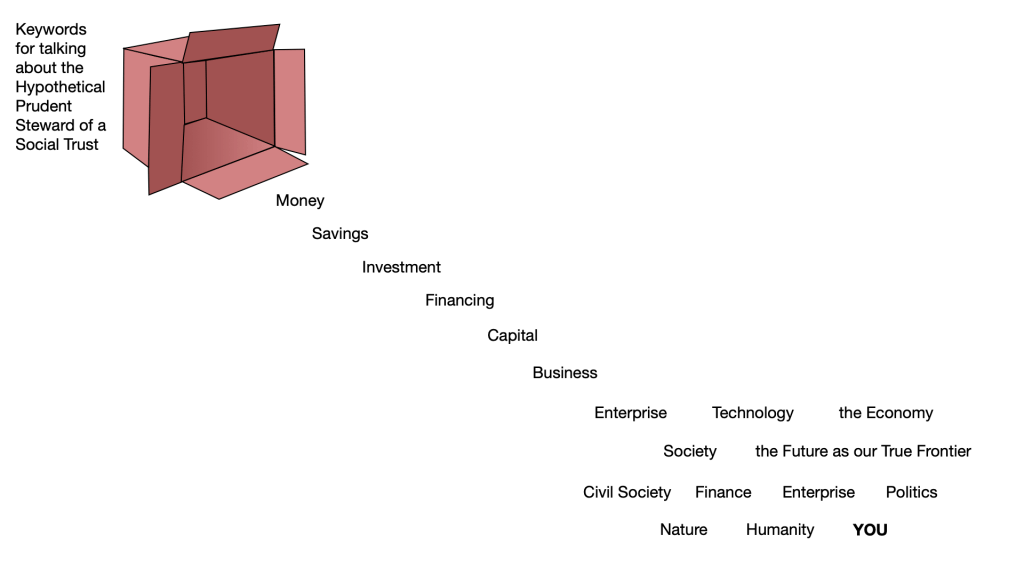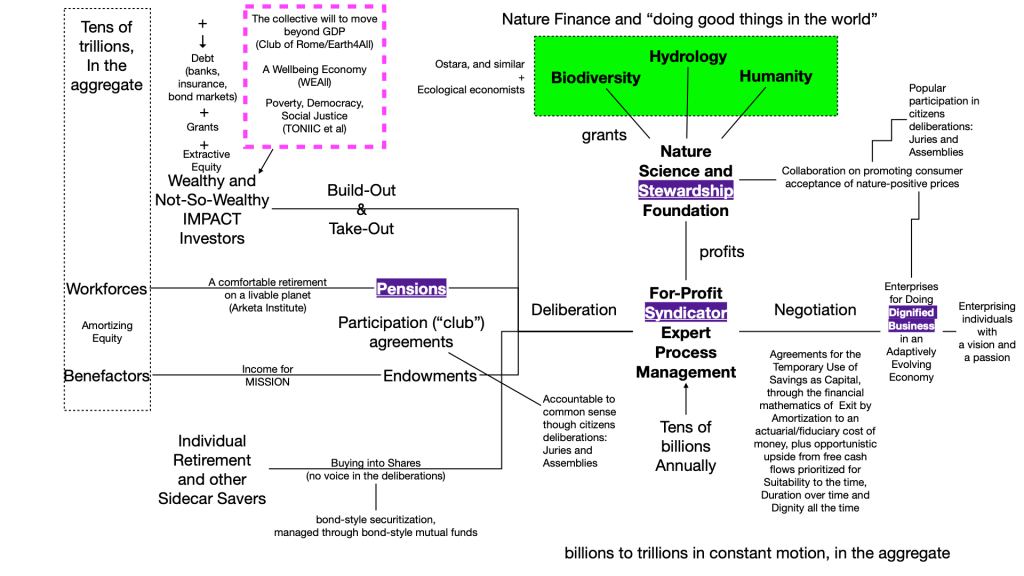
The main message of this relational map is Stewardship Syndication aligning the economy with “the rights and needs of the general population, of consumers, and the wider society” (Peter Ellis) through Pensions as “other than privately self-interested capital” (ibid) financing “non-shareholder purposed entities” (ibid) to form a new 21st Century planetary Stewardship of “the world we want” (Simon Mair) as “how we can make it happen” (ibid).
Pensions are the wealth of working people, aggregated in mutual aid, to finance “a comfortable retirement on a livable planet” (Arketa Institute) for so many, directly, as a private benefit, that it is also for us all, consequently, as a public good, on a planetary scale, and within planetary limits, in the 21st Century, and beyond….
Syndication is the work of allocating pension aggregations through the financial mathematics of Exit through Amortization.
This is how we mobilize “other than privately self-interested capital” to finance “non-shareholder purposed entities” that align the economy (“our time, that is nested within our times” [Maria Popova]) with “the rights and needs of the [workers as proxies for] the general population, of consumers and wider society” (Peter Ellis).
These rights and needs are for peace, with ourselves, with each other, with our planet and with our future.
Our time, that is nested within our times, is aligned with peace, and social cohesion, through contracts between Forever Money and Right for Our Times Business that prioritize Suitability, to the times, Duration, over time, and Dignity all the time in how money moves through Enterprise to curate our times, as good times, for some, and all.
Syndicators are experts in seeing Enterprise and the Economy through the lens of Exit through Amortization, to orchestrate and integrate these agreements between Money and Management.
They are conductors of a symphony of social cohesion through Dignified Business in an Adaptively Evolving Economy.

Enterprising individuals do the work of making and sharing wealth.
Syndicators keep the arc of caring within this making and sharing bending towards the peace of social cohesion.
An added benefit of Syndication orchestrating the flow of Forever Money into Dignified Business for caring about peace through social cohesion and connection is the ability illustrated on the map to place syndication business into steward-owned businesses to endow social purpose trusts.
Fees and profits earned through the orchestration of syndications can be made to flow up into grant-making foundations, and out, into the world, as grants to pay people for doing good things in the world that we want.
These twin-engines of prudent stewardship – contractual agreement for dignified business and profits endowing grants for doing good things in the world – give social change agents new powers for social change, whether your passion is:
- Nature
- Climate
- Biodiversity
- Water and Oceans
- People
- justice and equity across populations
- the Economy
- sustainable
- regenerative
- circular
- Doughnut
- Degrowth
- Wellbeing
- Government
- Civil Rights
- Consumer Protection
- Environmental Protection
- Democracy
They also give each of us and all of us, as citizens of “our time, that is nested without our times” (Maria Popova) points of participation for holding our institutions, of Forever Money, and Dignified Business, accountable for how they exercise the authority/power we give them, to act for us, socially, true to the agency/purpose/mission for which they are granted that authority, by us.
These opportunities for citizens deliberation include:
- holding Pensions & Endowments, as social stewards of Forever Money, accountable to our common sense of their prudence in their exercises of the capacity they derive from their legally constituted character, in undivided loyalty to their contractually specified aims, under the circumstances now prevailing; and
- promoting consumer acceptance of nature- and human-positive pricing in the markets for buying stuff, based on individually determined assessments of fitness for purpose and price for performance (purpose includes caring for consequences), within the socially determined constraints of availability and ability to pay.
The energy in all of this comes from the sheer scale of Forever Money in society today. Tens of trillions are aggregated, collectively, worldwide, into mutual aid societies for Workforce Pensions, and the promise of “a comfortable retirement on a livable planet” (Arketa Institute).
Additional trillions are aggregated to provision Civil Society Endowments for various Nature- and People-positive Missions.
That means that billions aggregating to trillions circulate through Enterprise in the Economy that are infused with the values that Forever Money is aggregated to value.
This can be multiplied through the devise of Side-car Funds that securitize participation interests in Stewardship Syndications negotiated by Syndicators working for “clubs” of Pensions & Endowments, making it possible for individuals to “ride-along” with Pensions & Endowments with our own money.
Also, Forever Money flowing through Exit through Amortization financings for Dignified Business opens up new possibilities for the Family Money of wealthy and also not-so-wealth families, to invest for IMPACT that aligns with Stewardship and Accountability through Deliberation, on a planetary scale and within planetary limits.
This can change the narrative of:
- Enterprise as
- a social reactor for transforming cost-for-value into value-for-price
- through social contract with popular choice
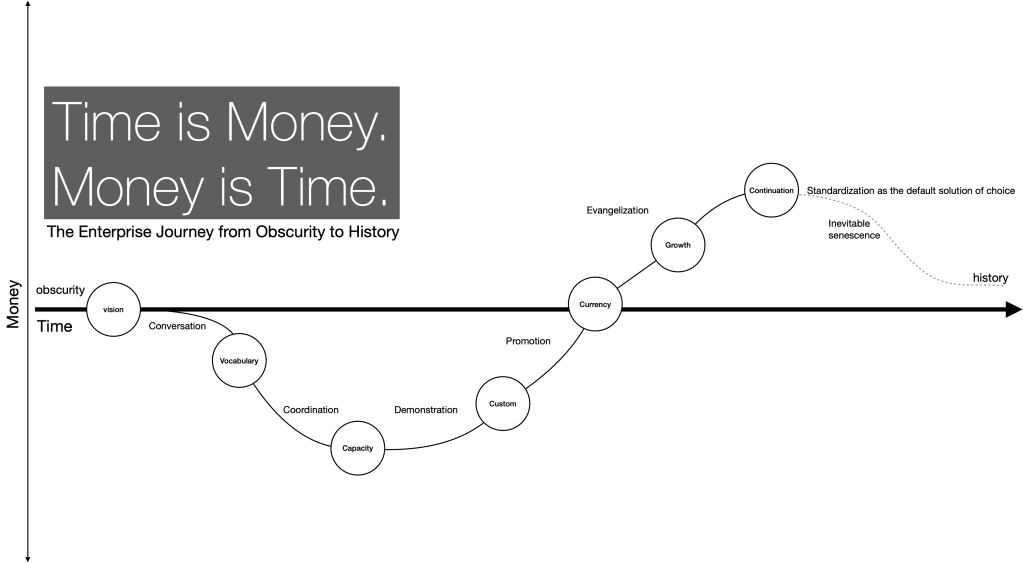
- that begins in obscurity and ends in history,
- flourishing for a time, before fading in the fulness of time,
- as times change, and humanity evolves prosperous adaptations to life’s constant changes,
- choosing new beginnings from time to time, and over time, to fit the changing circumstances of the changing times
- through inquiry for insight and new learning
- that can inform innovative new technologies
- that can inspire new enterprises
- for making those choices available to popular choice, that become more popular as better fit to the changing circumstances of the changing times, so that previously popular choices fade into history, as a good fit to the circumstances that prevailed at an earlier time; and
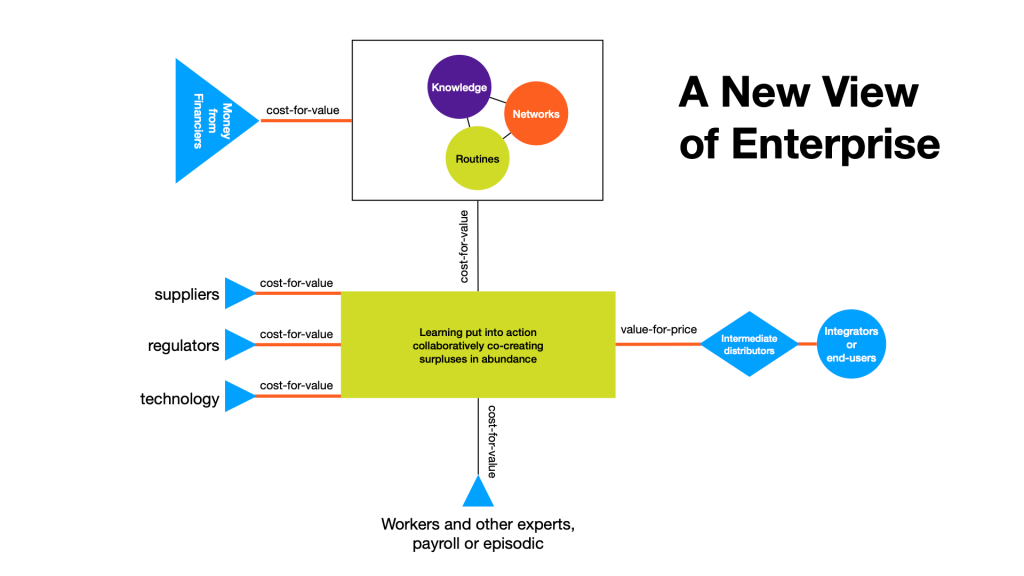
- Finance as supplying money as the capacity to do work to Enterprises as they journey through the flourish and fade of their social contracts with popular choice.
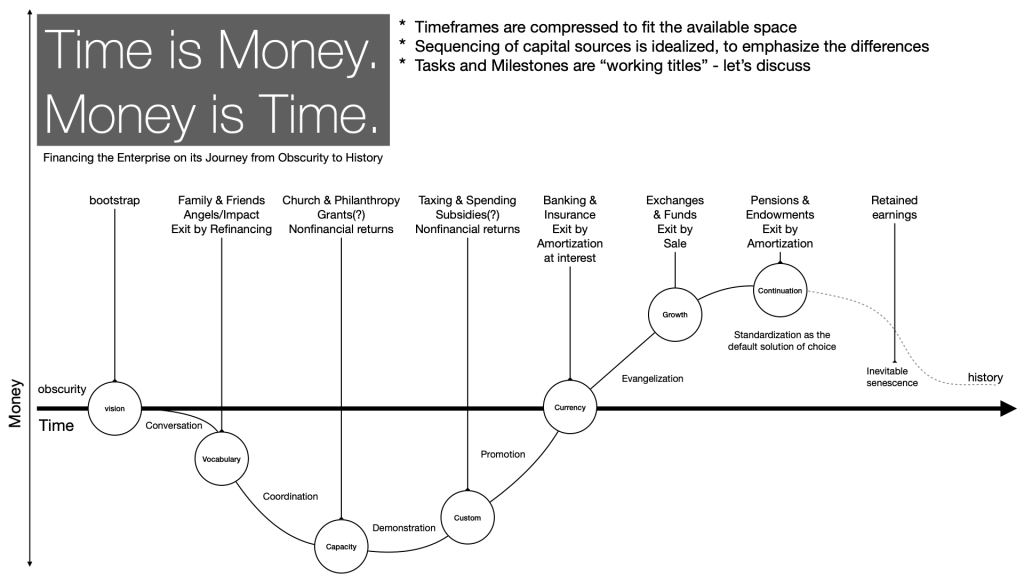
This gives us a new narrative of the Economy, not as a machine driven by self-interested rational actors, but as an open-ended evolution driven by inquiring minds.
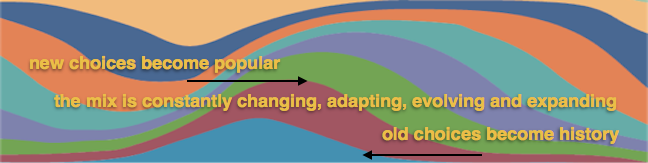

To participate, consciously, in the curation of this evolution, as citizens with the right and the responsibility to hold our institutions accountable for they choose, socially, for us, we need to learn new words, agree a new vocabulary, for talking about how this all happens.
The first word we need to lean is curation.
I recommend this word as best describing the truth of our human way of being in “our time, that is nested within our times”, because “curation” means selecting from among the available choices, by reference to a set of rules for what is right and true and good and beautiful.
And that is how we live, as humans.
We make selections from among what Nature makes available to us, and what we learn, through our technologies, and exchange through our enterprises, that we finance with our savings (our individual wealth that is aggregated into shared, or common, wealth), about how we can take what Nature gives us, and change it, to be more a way we choose to make it:
- curating “our time”, personally and privately,
- from the choices made available to us in “our times”, that we curate, socially, and publicly (through our institutions),
- from the choices that are made available to us, in Nature.
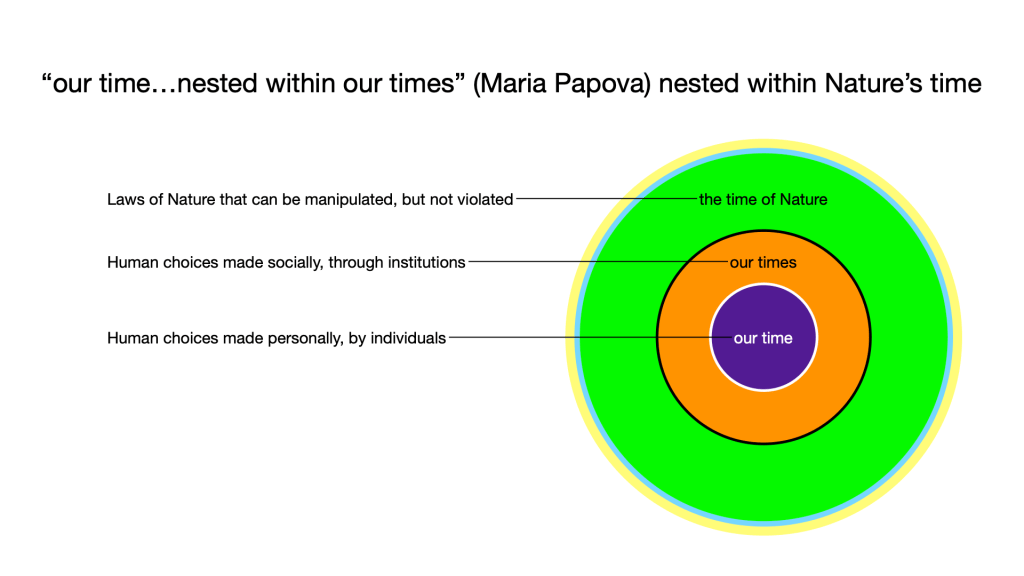
Curation requires conversation, and conversation requires a shared vocabulary, of words that resonate and reverberate, both intellectually and emotionally.
“We need both — knowledge and feeling, intelligent comprehension and emotional intelligence — to be capable of empathy, as well as self-compassion.”
– Maria Popova
Empathy is the animating spirit of prudent stewardship.
It is the antithesis of the rational self-interest that is perceived as driving firms and households in the exchange of good and services for labor and capital.
We cannot speak the values of empathy using the language of self-interest.
We need new words, words of prudence, words of stewardship.
Words that resonate and reverberate with empathy, with intelligent compression and emotion intelligence, with knowledge and feeling.
With both.