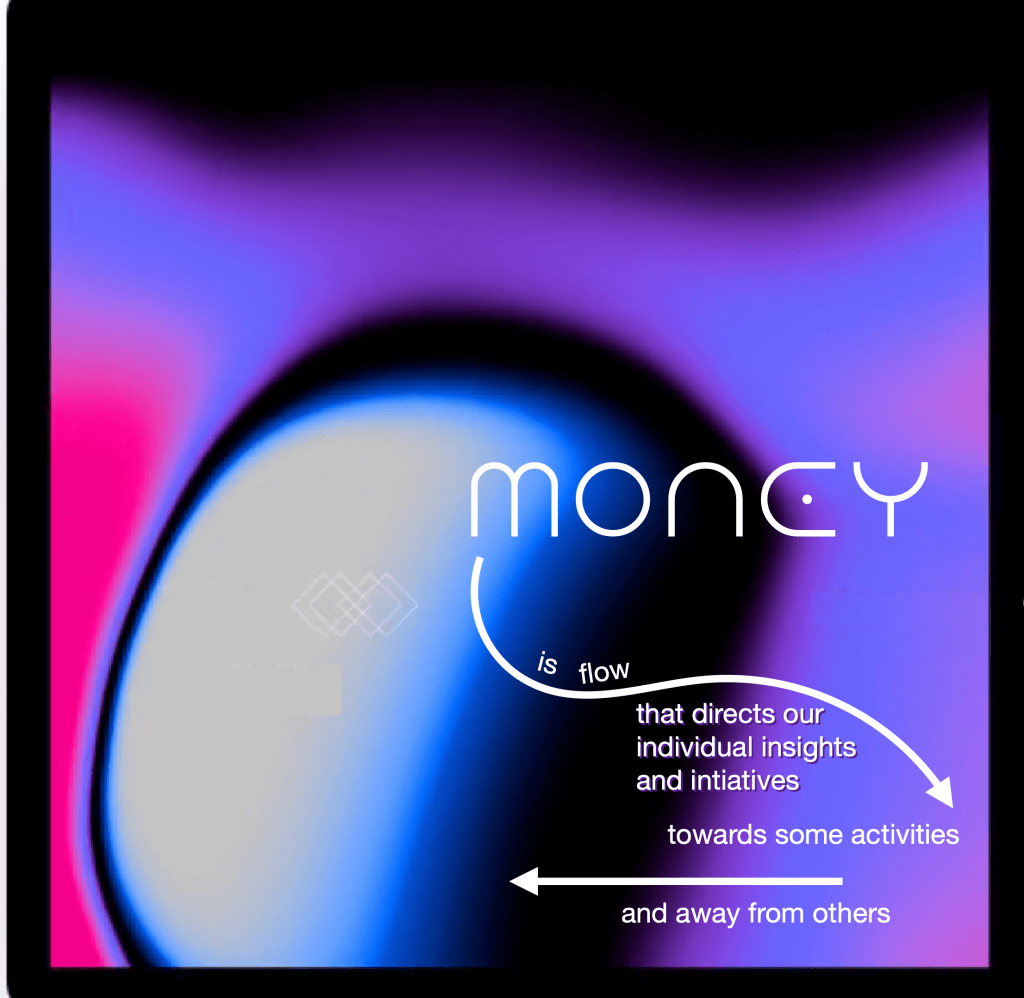
a technology that communities use to trade debts
Michael Mainelli
- a legal instrument of effecting transactions between people separated by distances of time, place and social connection (“you don’t have to trust the other person, if you can trust their money“)
- the social energy that directs our individual insight and initiatives towards some activities, and away from others
Money is one of the monsters in our time of monsters, because we do not really have a narrative for talking about money. We are told that it doesn’t really matter, and we should just leave it to the experts (it is the experts who tell us that).
But we all know that isn’t true. Which is terrifying.

There are few words in the English language that so completely express the roiling tumult of conflict and contentiousness that is our human way of being in the world as this one word, “money”.
By design, money is inert. A simple measure that in itself says nothing about the value of what is being measured. A purely factual recording of a quantity.
But what is being measured, what is being quantified by money, is our human relationships with each other; our worth, as a human, to another human.
And that is very dangerous territory, this territory of our worth to others. It is a symphony of rationality and and a cacophony emotion, of thinking and feeling, of thoughtfulness and thoughtlessness, every single note of which is sounded in some way through money.
Money does not exist in Nature. It is completely made up, a purely human invention. A thing that is no thing. Nothing.
And yet it is the most powerful thing in the whole of human experience. The root of all evil. And the best revenge.
We all use money. Some of us want it.
Some wish we did not have it. We all need it. Few really understand it. Because our stories about money are as confused and conflicted as the relationships that we energize through money.
To have money is to have power over others. To be without money is to be without power, forced to become indentured to others, or driven to rely on our wiles in an effort to beguile.
To be sure, there is an empirical residue of human emotion that manifests without money: the care and caring of mother for child, of family and friends; the animosities of rivals and hatred of enemies.
But mostly, people live together using money.
Given the importance of money to our human way of being together in society, it seems we should have a universally accepted and clinically precise language and vocabulary for talking about money, much the way we have a language for talking about language. We know what words are and how they are used. When they are being used correctly, and when they are being corrupted.
But we don’t know so much about money.
Why not?
 Shifting to Equity Paybacks