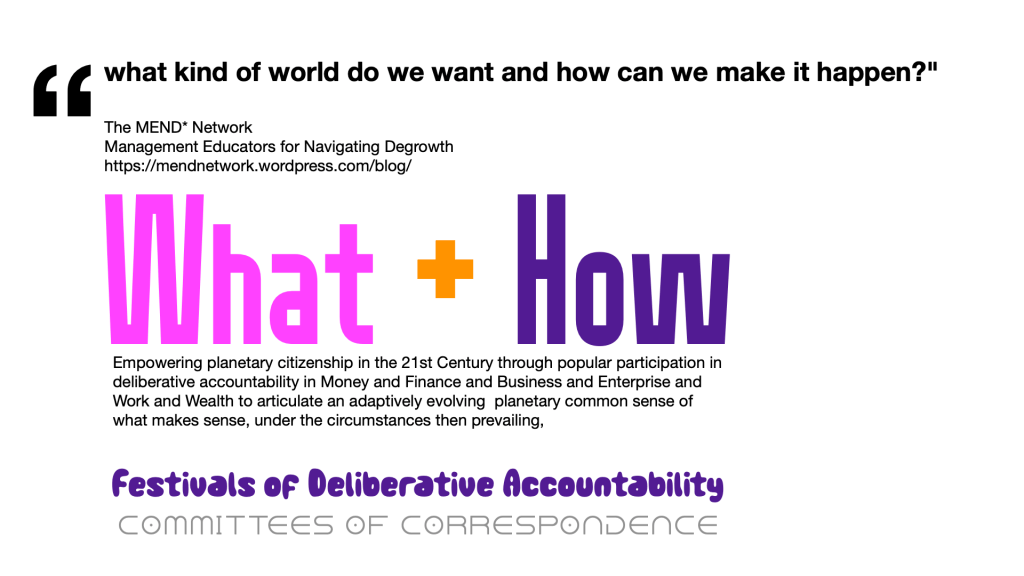
The purpose of this movement is to organize and energize a new 21st Century planetary citizenship in the fiduciary accountability of forever money, as a new 21st Century planetary commons.
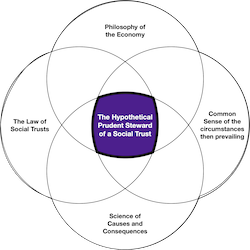
This is citizenship through deliberation to articulate an adaptive evolving common sense of prudence in the exercise of capacity derived from character, under the circumstances then prevailing, in undivided loyalty to aims, by Pensions & Endowments as stewards of the tens of trillions in society’s “forever money” aggregated into social trusts for provisioning mutual aid societies for assuring income security in a dignified future to so many, directly, as a private benefit, that it is also, of necessity, for us all, consequently, as a public good.
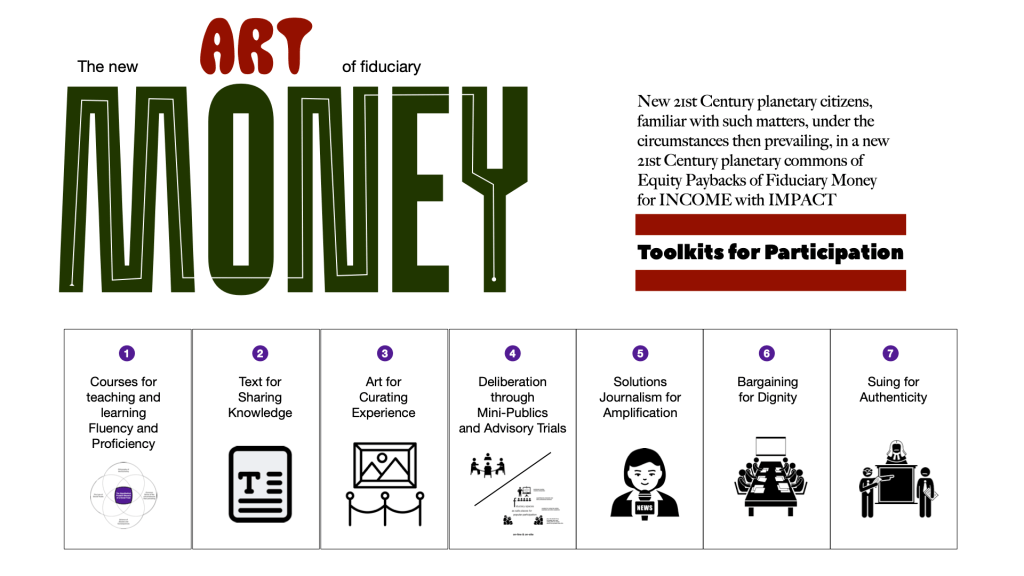
There are 9 moments in this movement:
- formal teaching and learning of keywords in context, for fluency and proficiency in the new language of planetary citizenship
- briefing papers on the changing circumstances of the changing times
- art as social objects around which conversations can happen
- dramatic performances of citizens juries and assemblies
- solutions journalism, for sharing the results of organized deliberations, to broaden the conversation at the vanguard of public discourse
- bargaining with Pension & Endowments fiduciaries, to align their exercises of their plenary powers of discretionary authority with our shared common sense of what make sense in Enterprise and the Economy
- litigation in courts of law, if and as necessary, if and whenever fiduciary practice deviates from our shared common sense, evolved through deliberation, of their prudence and loyalty.
Keywords in Context
Conversation requires agreement on the meaning of words.
Otherwise, the meaning intended by the speaker of words will to be the same meaning understood by the people who hear those words.
There will be a breakdown of communication: false resonance, when people think they are in agreement, but really are not; and false dissonance, when people think they disagree, but really do not.
This is a threshold problem in our conversations at the vanguard of public discourse today, about Money and Finance and Enterprise and the Economy, and many misunderstandings that flow those cultural miscommunications.
Too much of our communication about Finance and Enterprise, and what is right and true and good in the Economy, is expressed in words of general import that are being encoded with specialized intention, so that words that are being spoken by experts to reference their own self-interest are being by the general population as being of general interest.
Which is why so much public discourse on these topics today sounds like noise: the false resonance of misaligned meanings that leads to disappointed expectations; and false dissonance that impedes consensus agreement.
Take the word “investment”, for example.
In common parlance, investment means, generally, transferring to others the capacity to do work. The word itself is not generally understood as specified what capacity, exactly is being transferred, to whom , for what purpose, or through what mechanisms. Those are details that all need to be added, through the use of additional words that describe those details, in the particular context under consideration.
But the securities trading markets professionals have, since the 1970s, and perhaps earlier, succeeded in co-opting this word of general meaning – investment – and encoding with the particular meaning of providing financing to corporations, for growth, through securities trading.
In this way the word growth, which is another word of general meaning in common parlance, has been specially encoded to mean increases in the selling prices for securities in the markets for maintaining selling prices for securities.
In the process there is a subtle but pernicious corruption of our common sense of Money and Finance and Enterprise and the Economy, through false resonance – we think we agree with securities trading markets professionals, about the central role and defining importance of securities trading in financing enterprise to curate the economy, when really we do not; and false distance – we think we disagree with critics of this inauthentic corruption of our common sense when really, we agree with them.
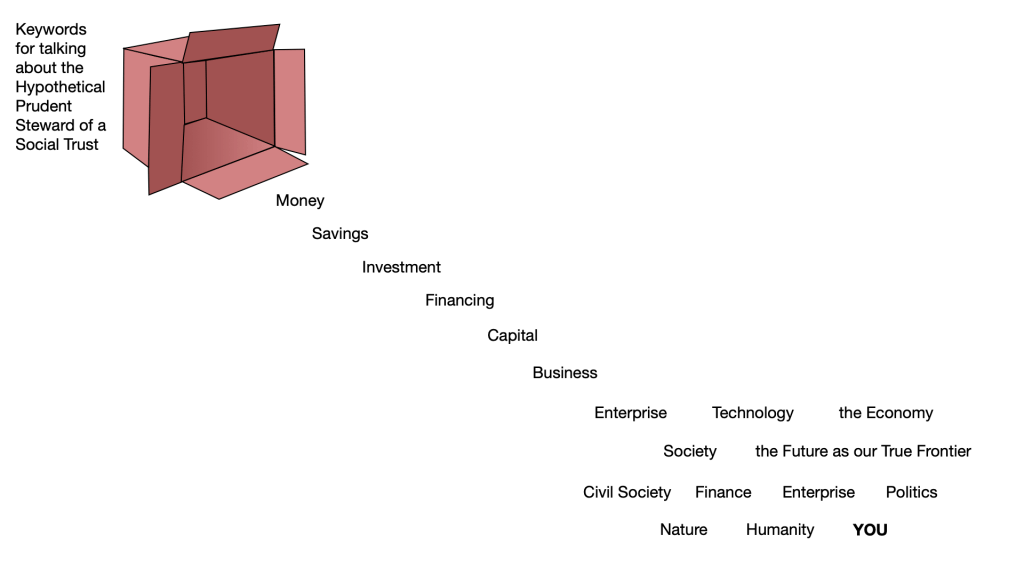
To quiet this noise, and rectify the resonance and the dissonance, we need to go back to the text to agree on the context and intended and understood meaning of key words such as:
- money
- savings
- investment
- financing
- capital
- business
- enterprise
- technology
- the economy
- society
- the future
- Civil Society
- Finance
- Enterprise
- Politics
- Nature
- Humanity
- YOU!