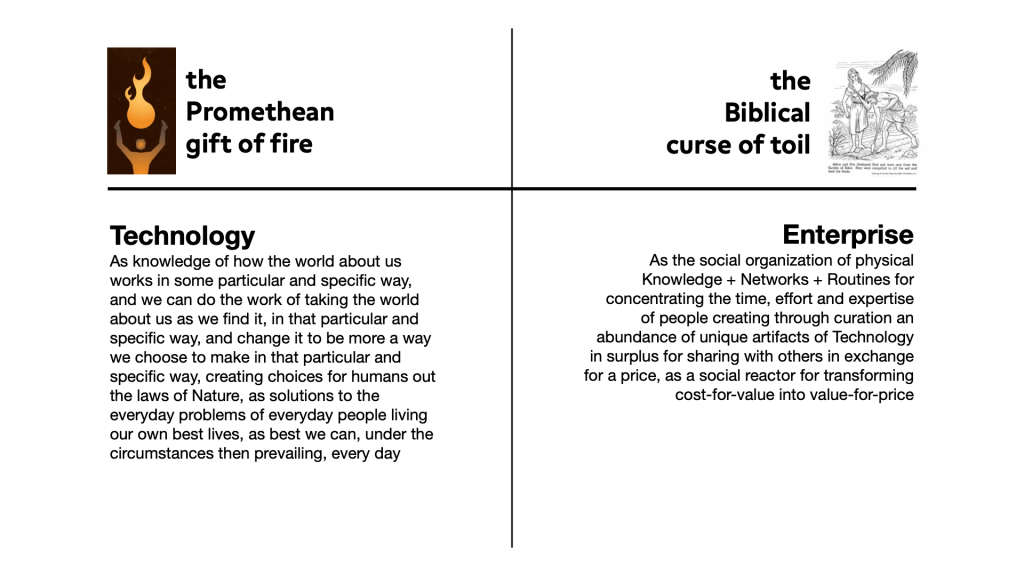
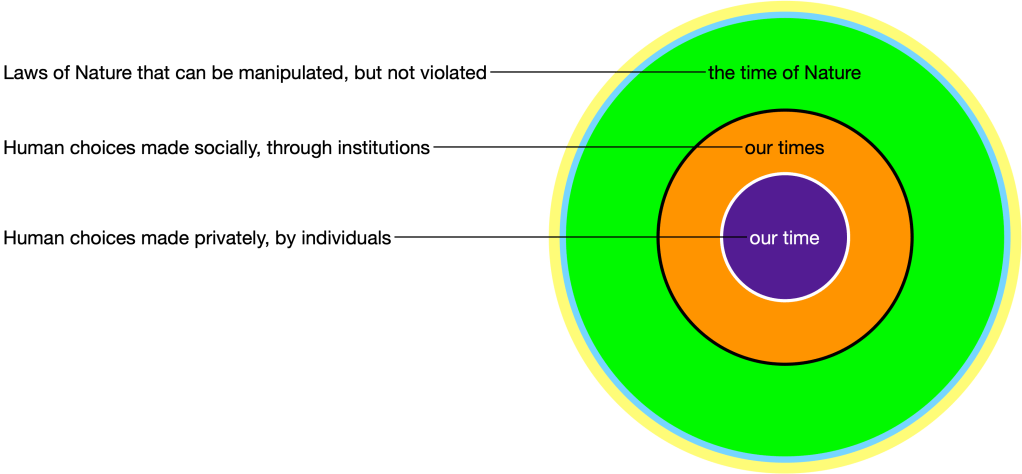
We make our worlds through work, as the concentration of time, effort and expertise to take the world about us as we find it, and change it to be more a way we choose to make it.
Work is careful, and caring.
It is collaboration and sharing.
That is the Promethean gift of fire, as the aborginal technology. It is language for talking about how the world about us works, and how we can take the world abiout us as we find it, and change it, to be more a way we choose to make it.
In this sense, we make our worlds through words, for organizing our work.
One form of collaboration is competition, which is conflict.
And so we get this roiling turmoil of caring and conflict that is our uniquely human way of being in worlds we make, through our technologies – our words about work – out of the world of Nature into which we each and all are born.
This is the Bibical curse of toil.
Toil requires specialization, to create through curation an abundance of the unique artifacts of our technologies in surplus to our own individual needs.
We can share these surpluses with others, in echanges for a share in the surpluses they create through their curation of their technologies.
We effect these exchanges using money. We empower the curation of technoloiges to crate surpluses for exchange using money.
We make our worlds with money.
Work.
Words.
Money.
These are the uniquely human creations – we make these things out of noting, by sheer force of will, and agreement within populations – through we make our human versions of the natural world into which we each and all are born, and upon which we each depend, for our own being, and being well.
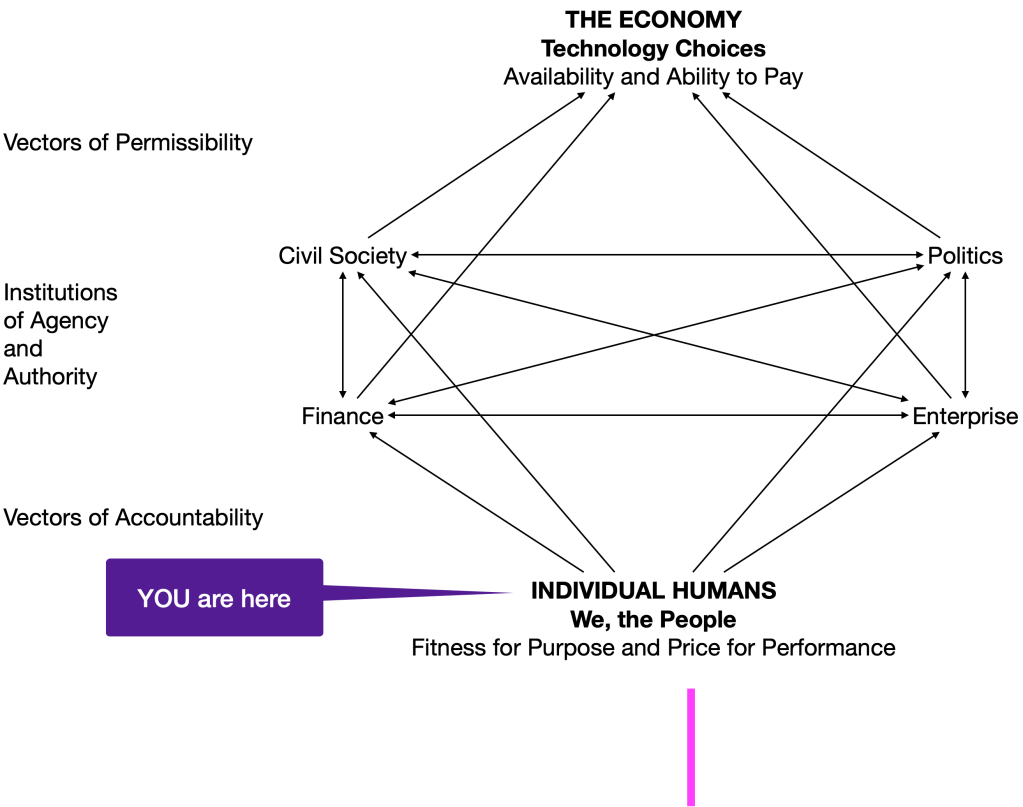
We use words to move money to organize work:
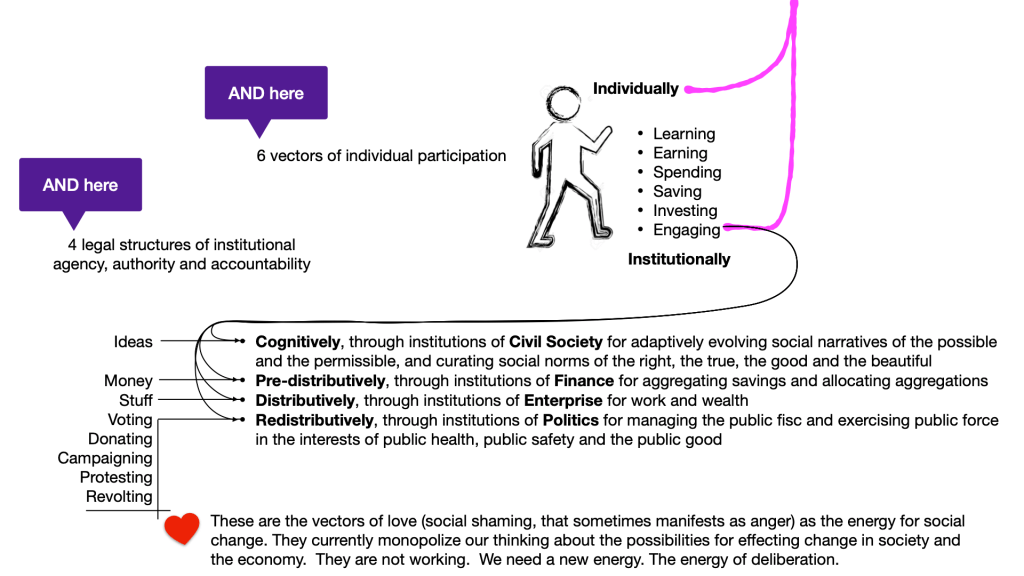
Individually, as
- learners, of technologies
- earners, through effort and expertise
- spenders, of what we earn
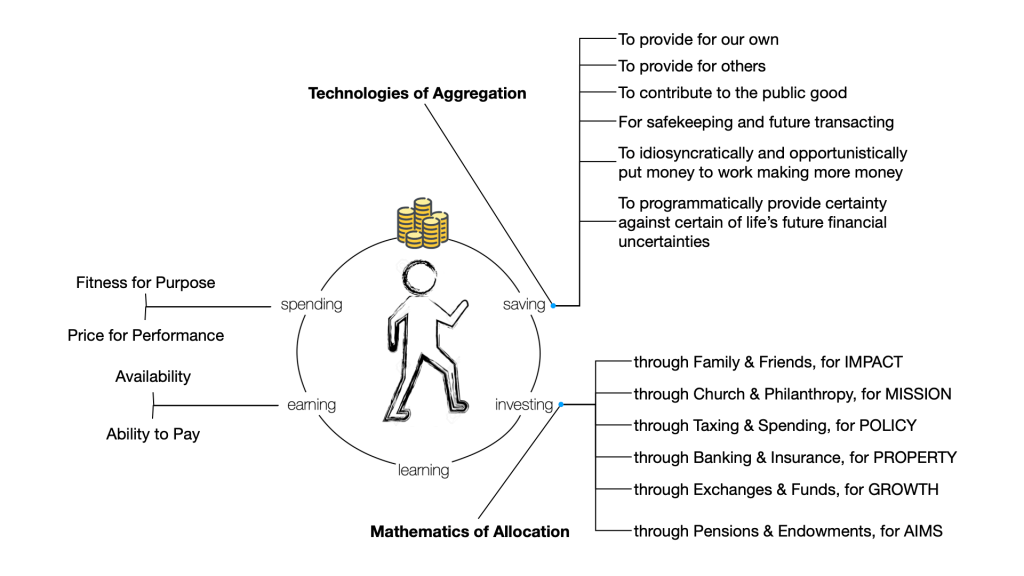
- savers, of what we earn and choose not to spend, currently
- investors, in the work and wealth creation of others
- engagers, in the social work of holding soical institutions of agency and authority for making choices, about caring and conflict in the cration through curation of our shared, social worlds, accountable for authentiiaty and integrity in their individual exerxises of their institutional authority/power true to their institutional agency/purpose/mission.
Institutionally, through self-perpetuating, hierarchial social bureaucracies of
- Civil Society, for adaptively evolving our shared scoial narratives of the possible and the permissible, and curating our social norms fo the right, the true, the good and the beautiful, through:
- Inquiry for Insight through
- research
- scholarship
- education
- Art
- Science
- Culture
- Religion
- History and the Humanities
- Publishing, Journalism, and Popular Participation in Conversation at the vanguard of Public Discourse
- Spectacle, and
- Oracle
- Inquiry for Insight through
- Finance, for aggregating money set aside by others, for a future purpose, for a future time, as savings made available for investment in financing for Enterprise to supply business with Capital as capacity to transform cost-for-value into value-for-price, and allocating those aggregations through the financial mathematics for calculating the cost charged to Enterprise for the use of that capacity, from which qualifications for financing (the temporary transfer of Money as Capacity) , the time and timing of the financing, and the terms and conditios that must be honored to continue the financing in place as orginally agreed, all flow, through
- Family & Friends, aggregating savings set aside to provide for our own, and allocating those aggregations through the fiancial mathematics of patrognage for IMPACT;
- Church & Philanthropy, aggregating savings set aside to provide for others, and allocating those aggregations through the financial mathematics of grants for MISSION;
- Taxing & Spending, aggregating savings set aside (albeit by force of [tax] law) to contribute to the costs of public health, public safety and the public interest, and allocating those aggregations through the financial mathematics of subsidies for POLICY;
- Banking & Insurance, aggregatig savings set aside for safekeeping and future transacting, and allocating those aggregations through the financial mathematics of monetization of PROPERTY (money lent for a time, against a promise to repay, plus interest);
- Exchanges & Funds, aggregating savings set aside to iidiosyncractically put moey to work opportunistically making more money,, and allocating those aggregations through proft extraction from GROWTH; and
- Pensions & Endowments, aggregating savings set aside to programmatically provide certainty against certain of life’s future financial uncertainties, and allocating those aggregations through the prusence excercise of capacity derived from character, under the circumstnaces then prevailing, in undivided loyalty to AIMS.
- Enterprise for concetrating the time, effort and expertose of others to do the work of transforming cost-for-value into value-for-price through the application of technology to make choices, and the abilty to choose by paying the price, available to others, as solutions to the everdyay needs of everday people for:
- Energy & Materials (the stuff of which technology choices are made)
- Nutrition (food and water, and all that is entailed in supplying peope with food and water);
- Habitation (clothing and construction, and all the infrastructure of human being in phsyical space)
- Knowledge, Information and Communication (words and all that is conveyed through the exchange of words).
- Politics for managing the public fisc (Government Taxing & Spending) and exerciseing public force (law and regulation) within different communites of place, and of interest.


 Shifting to Equity Paybacks