More Quantities of Money for securities trading markets professionals ≠ a better Quality of Life for us all
The Securities Trading Markets Need GROWTH. The Economy needs sufficiency under the circumstances then prevailing.
Money Matters
Finance Matters
Fiduciary Money Matters
Fiduciary Finance Matters
Asset Ownership is a corruption of the code of Prudent Stewardship
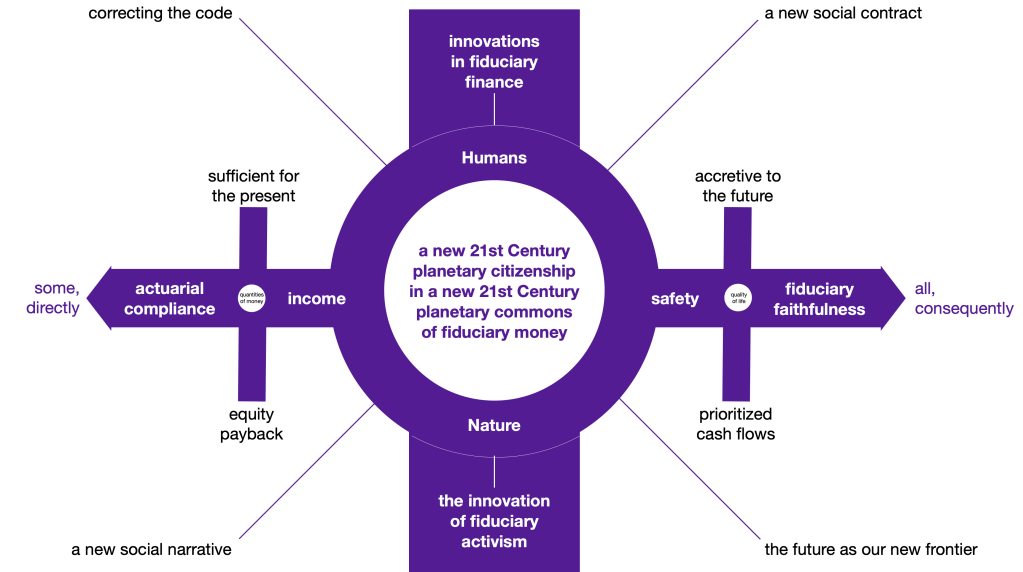
Equity Paybacks correct the Code of Prudent Stewardship
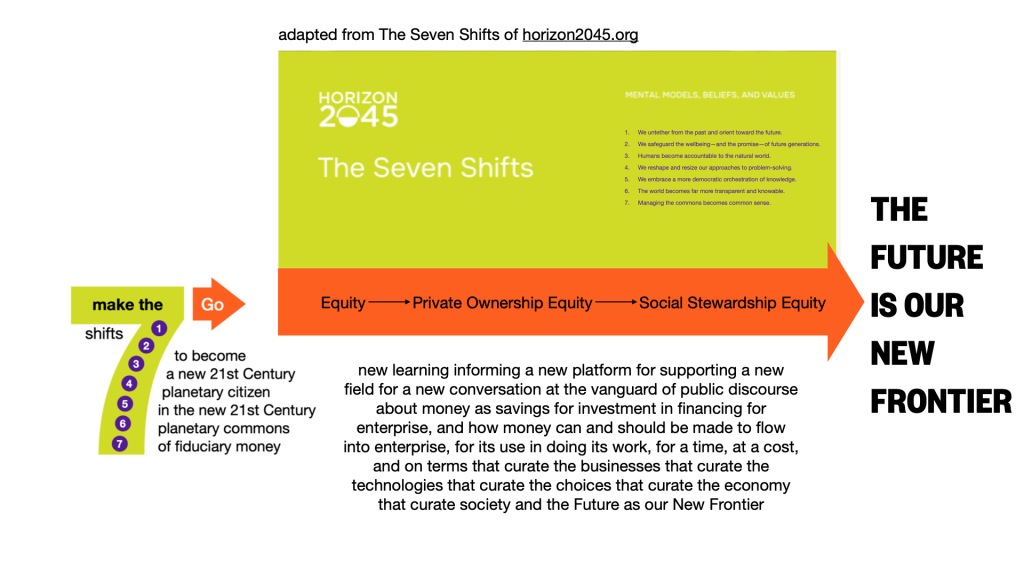
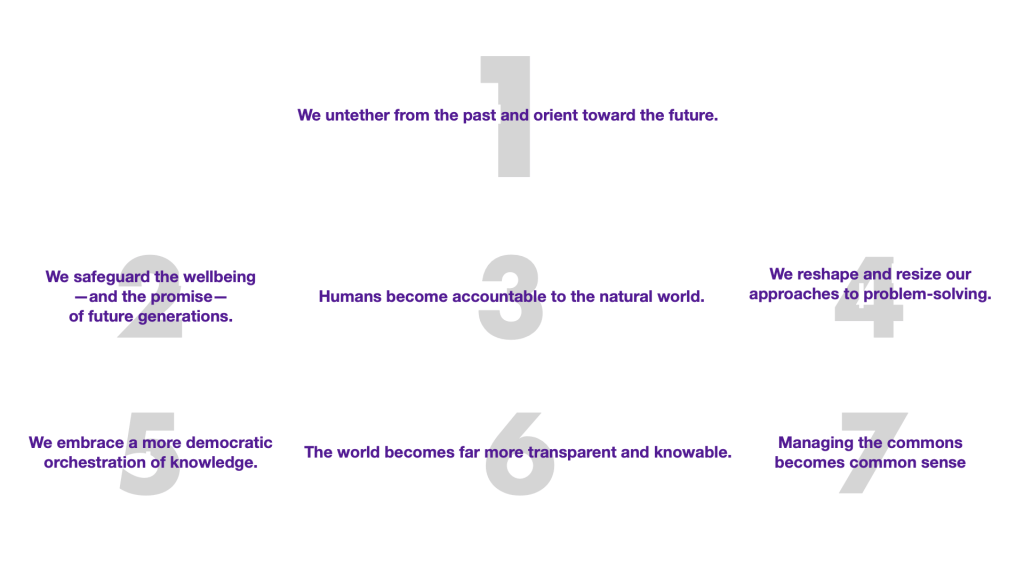
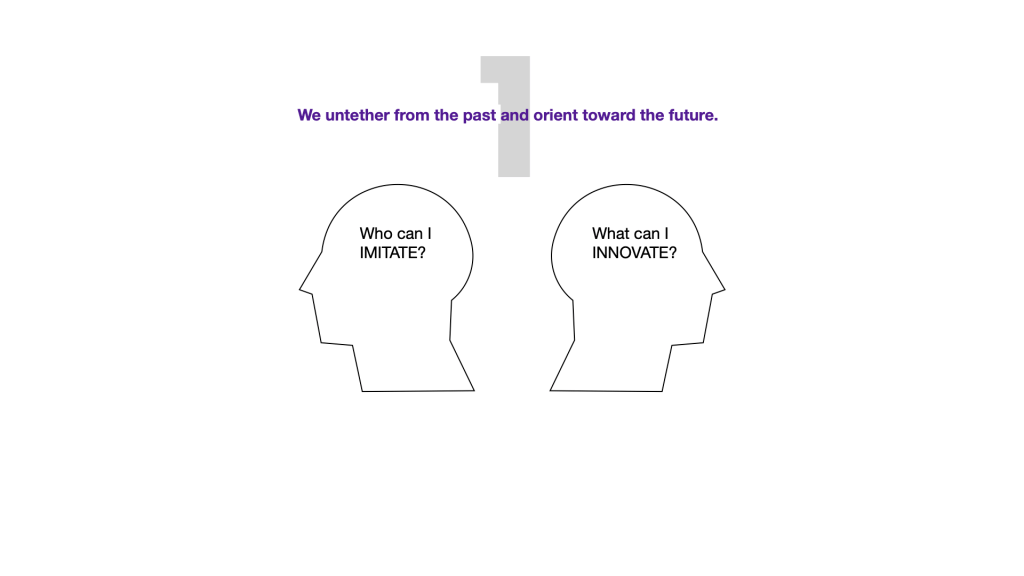
We untether from the past and orient toward the future.
Private Ownership Equity reduces history to a trend line and shows us our future as a forward projection of this historical trend line, creating booms that go bust when the trend line fails, giving the lie to the axiomatic assertion of Capital Markets control over Fiduciary Money, that more will always be better.
Social Stewardship Equity dwells along the creative edge of the future as our new frontier, choosing new beginnings from among evolving possibilities, and their consequences, as times change, to fit the changing times.
We safeguard the wellbeing—and the promise—of future generations.
Private Ownership Equity speculates on share price movements in the share price trading markets, timing and riding the booms and busts of trend line-based future forecasting.
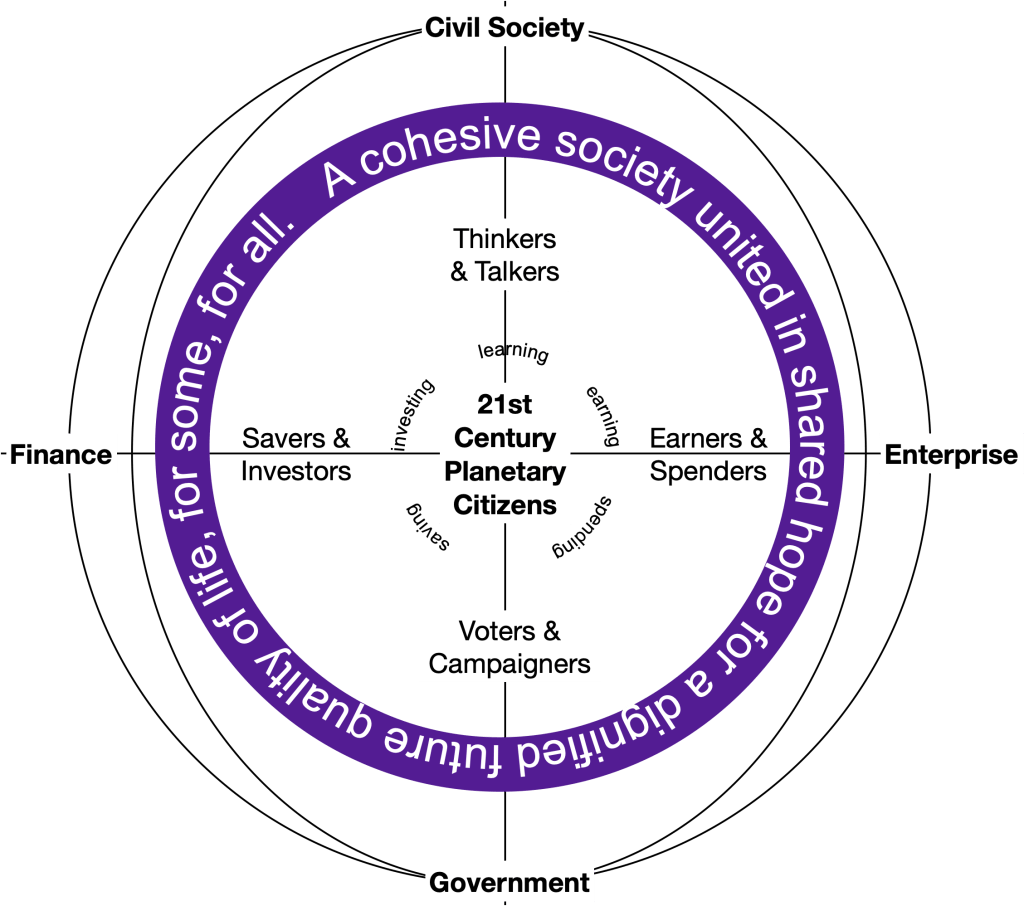
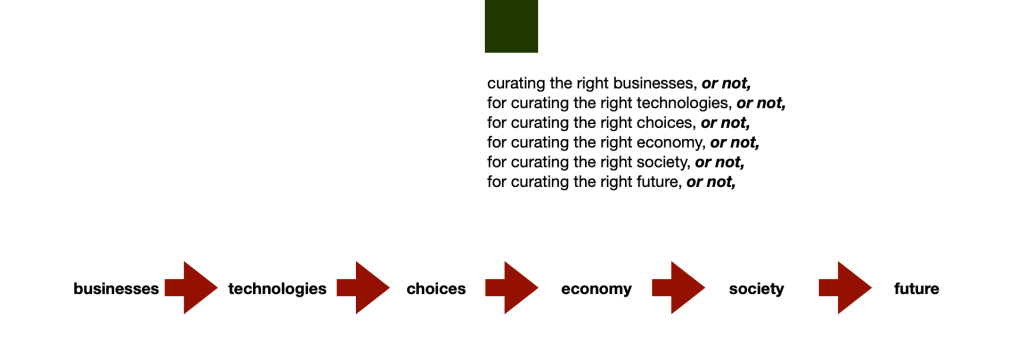
Social Stewardship Equity negotiates equity paybacks to an actuarial/fiduciary cost of money, plus upside, from enterprise cash flows prioritized by contract for suitability of its core technology to the changing times, duration of its social contract with popular choice, and dignity across all six vectors of enterprise cash flow to curate the right enterprises for curate the right technologies for curate the right choices for curate the right economy for curate a cohesive society, and keeping it ongoing, united in hope for a dignified future quality of life, for some, and all.
Humans become accountable to the natural world.
Private Ownership Equity operates within an experience that Nature is vast, and we are not. We can take, and take and take from Nature without ever reckoning with the consequences of our takings, because those consequences will just disappear into an infinitely receding geobiophysical frontier, reabsorbed back into Nature without consequence. To us..
Social Stewardship Equity operates with an experience that Nature is vast, and so, now are we. When we take from Nature, we must always reckon with the consequences of our taking. Because there will always be consequences. For us.
We reshape and resize our approaches to problem-solving.
Private Ownership Equity operates at the scale of markets, on the assumption that markets can and do always expand, endlessly and exponentially. Because growth in markets is necessary for growth in transaction volumes, and growth in transaction volumes is necessary for growth in share prices, and growth in share prices is necessary for Private Ownership Equity to extract a profit from the markets.
Social Stewardship Equity operates at planetary scale, to mediate the tensions between here and there, now and later, you and me, along all six vectors of cash flow connections that curate the businesses that curate the technologies that curate the choices that curate the economy that curate society and our shared future.
We embrace a more democratic orchestration of knowledge.
Private Ownership Equity is elitist and authoritarian, requiring specialized knowledge of financial instruments and trading protocols, and a feel for the mood of the market that excludes all who are not sufficiently expert, and “tapped in”.
Social Stewardship Equity is inclusive and democratic, referring the details to experts in those details, but engaging with the common sense of reasonable people who care enough to take the time to make the effort to acquire knowledge and experience relevant to the possibilities, and their consequences.
The world becomes far more transparent and knowable.
Private Ownership Equity shows us the economy as the production and distribution of goods and services in markets for allocating scarcity through the mysteries of price that are irrationally presented as operating rationally, which is crazy.
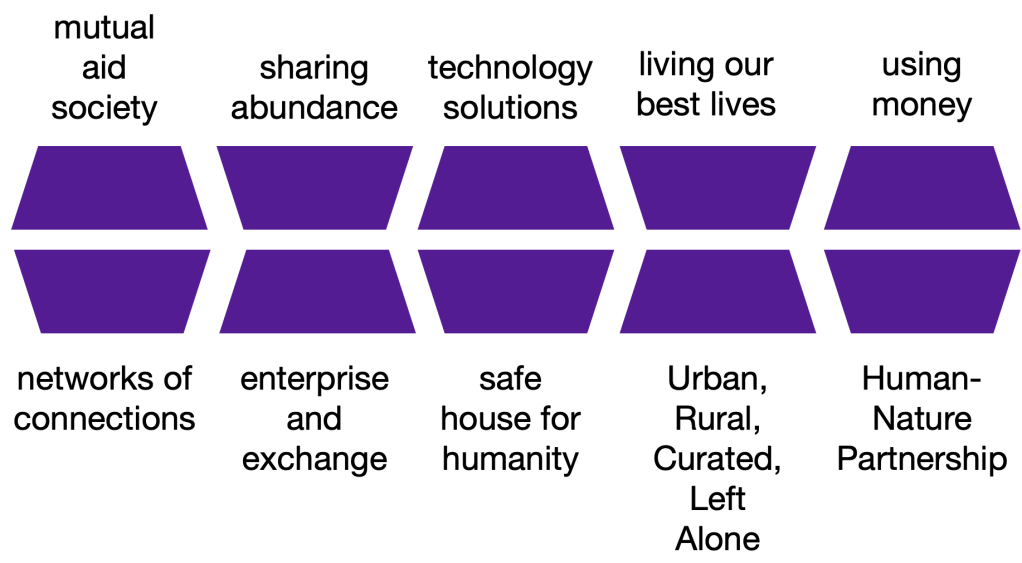
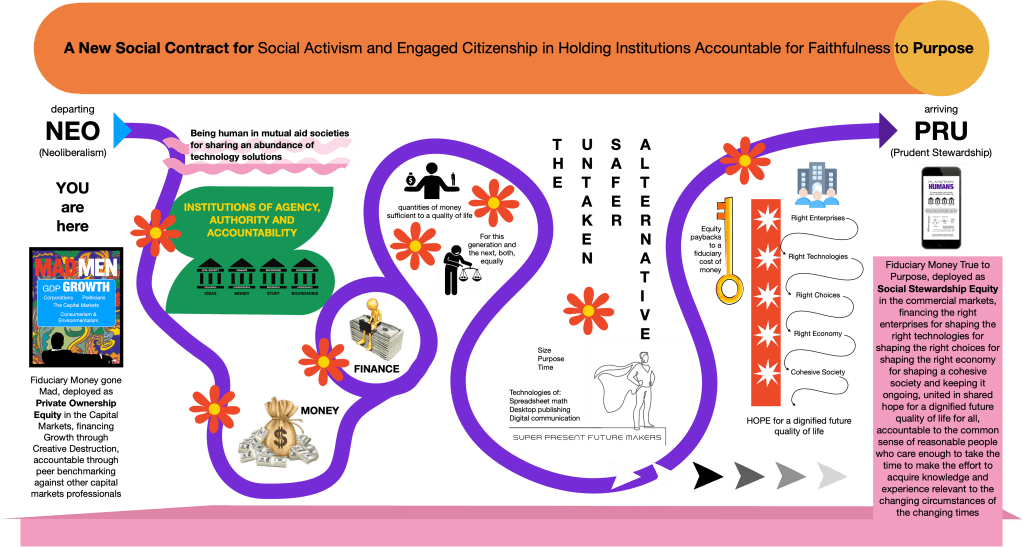
Social Stewardship Equity shows us the economy as a mutual aid society for sharing an abundance of technology solutions to the everyday problems of everyday people living our best lives under the circumstances, every day, through networks of connections for enterprise and exchange to construct and reconstruct a safe and dignified house for humanity along the creative edge of an evergreen, ever-changing adaptively evolving Human-Nature partnership, which is human.
Managing the commons becomes common sense.
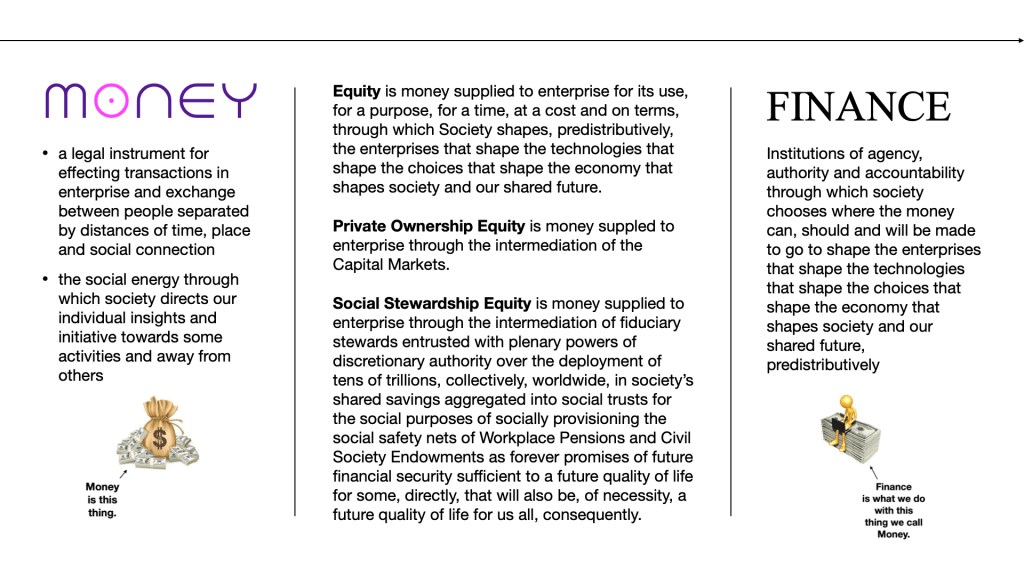
Private Ownership Equity makes money for finance, and the profits that can be made by deploying money for finance, private, personal and individual, making participation in the economy through saving and investing a zero-sum game of winner take all.
Social Stewardship Equity celebrates society’s shared savings aggregated into social trusts for the social purpose of socially provisioning the social safety nets of Workplace Pensions and Civil Society Endowments as forever promises of a dignified future for some, directly, and for us all, consequently, as a new 21st Century global commons that is accountable to the shared common sense of a new 21st Century planetary citizenship.
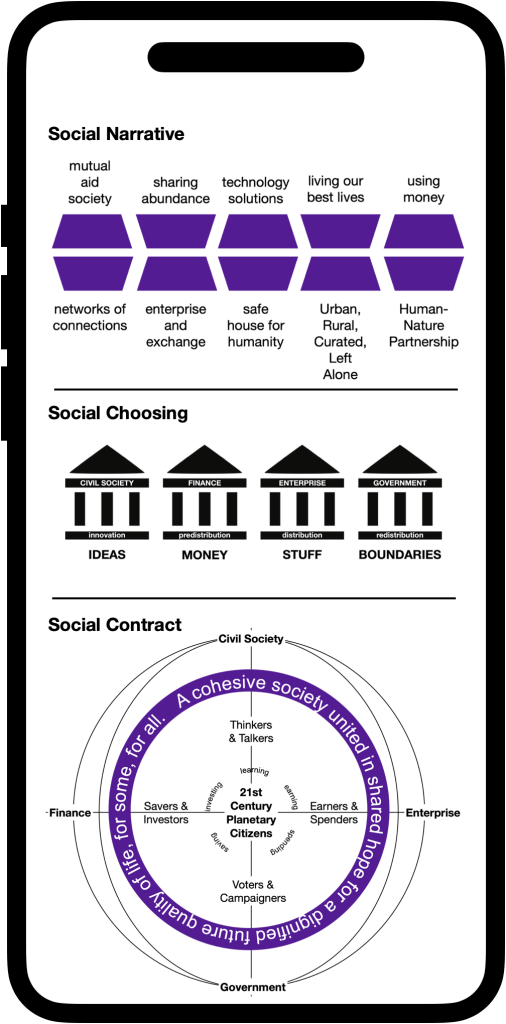
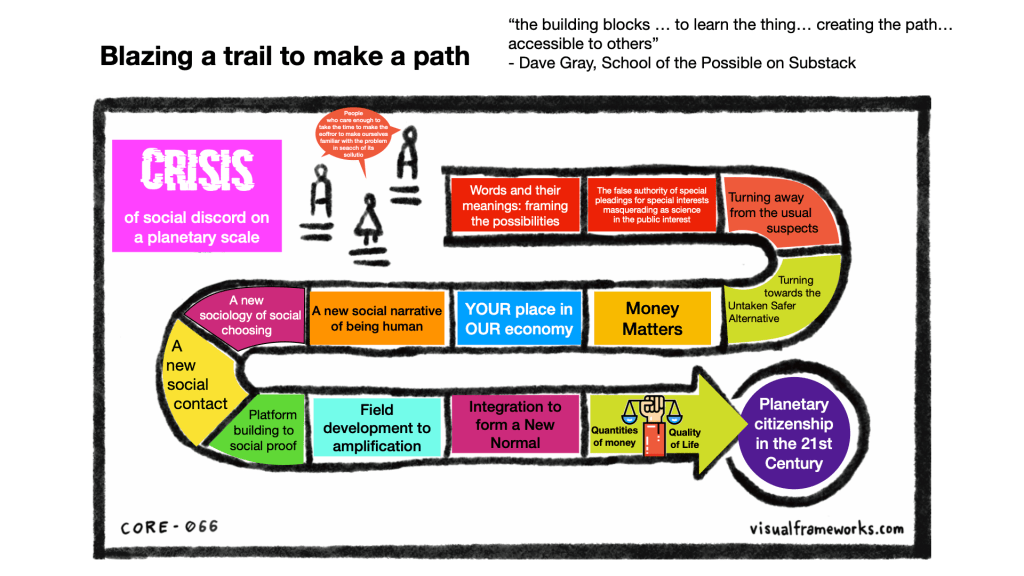
A New Social Narrative of the Economy
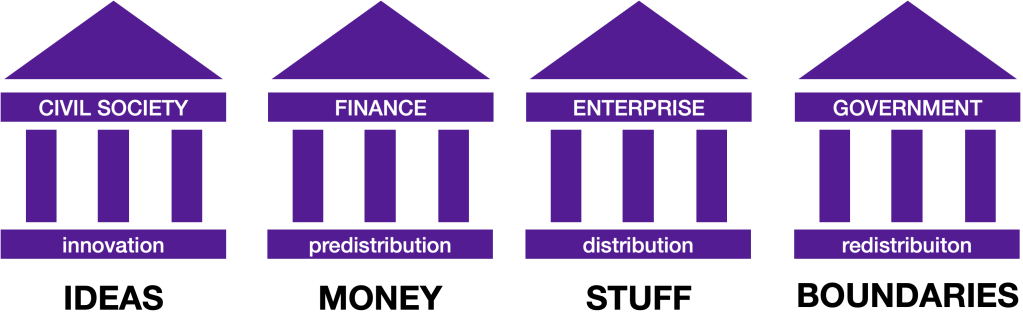
A New Sociology of Social Choosing
A New Social Contract of Institutional Accountability
Monitored from your handheld
what starts out as a narrow, technical inquiry into the fiduciary capacity of fiduciary stewards of fiduciary money
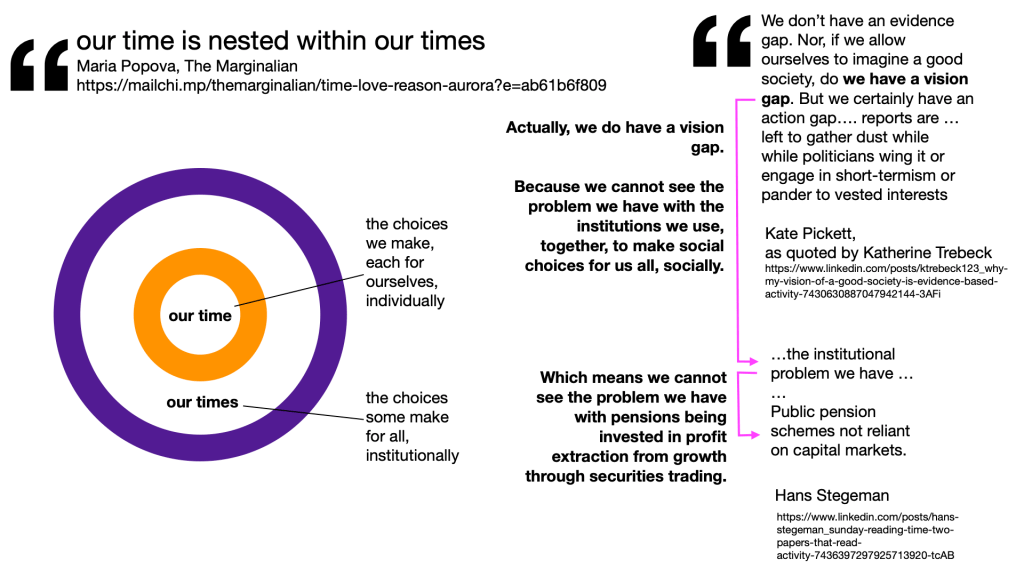
Adaptively evolving a new social narrative of “our time that is nested within our times” (Maria Popova) nested within Nature’s time
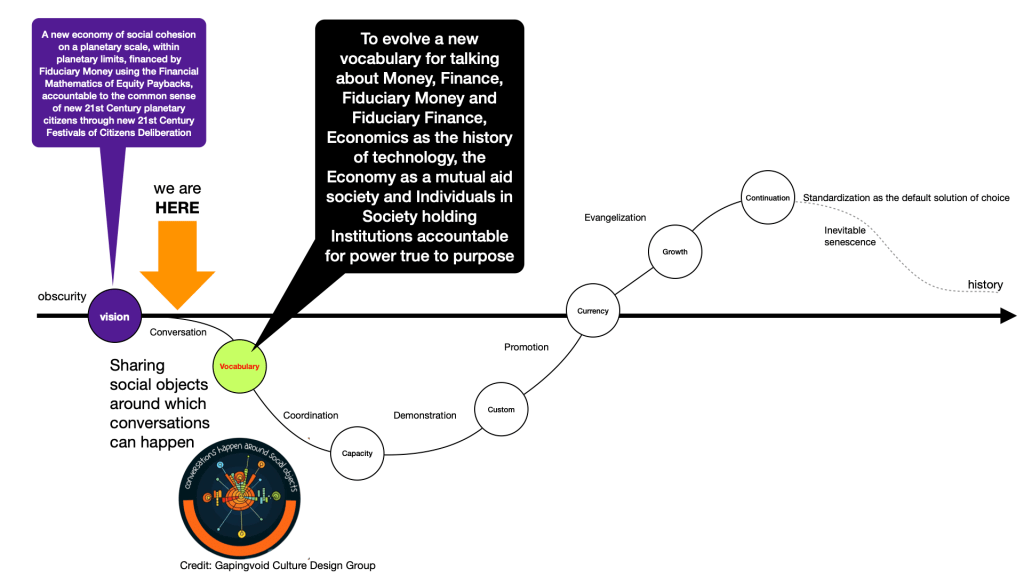
This is where we are today.
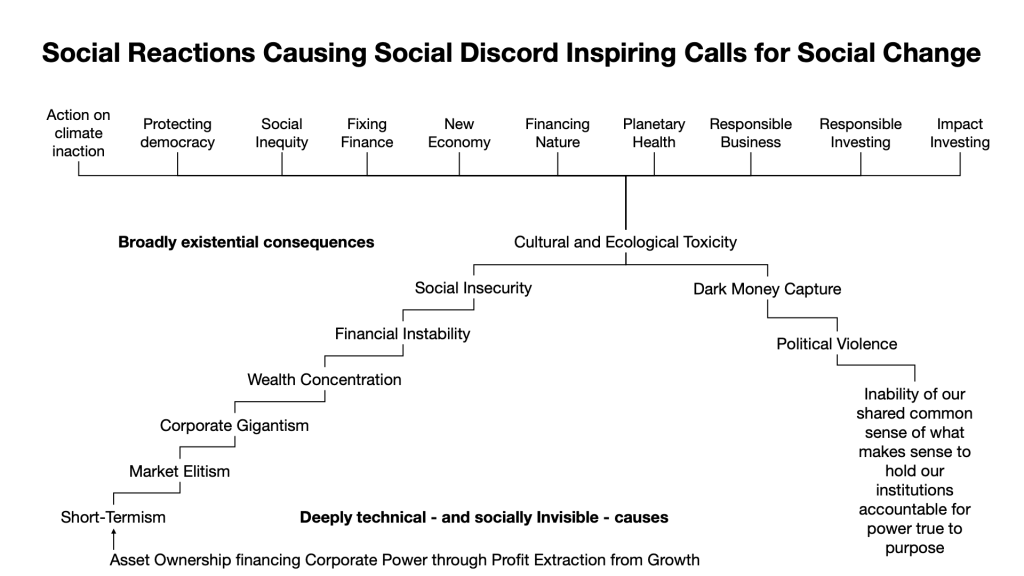
Learning to see the economy as a social reactor, for social cohesion, when it functions correctly, curating the right reactions, and for social discord, when it does not…
and that money is the social energy that powers those reactions,
and that when institutional control over money disconnects itself from accountability to common sense, it stops powering the right social reactions for social cohesion in the economy, and starts powering reactions for social discord.
The institution of Fiduciary Money has become
disconnected from our common sense of their capacity, prudence and loyalty, and
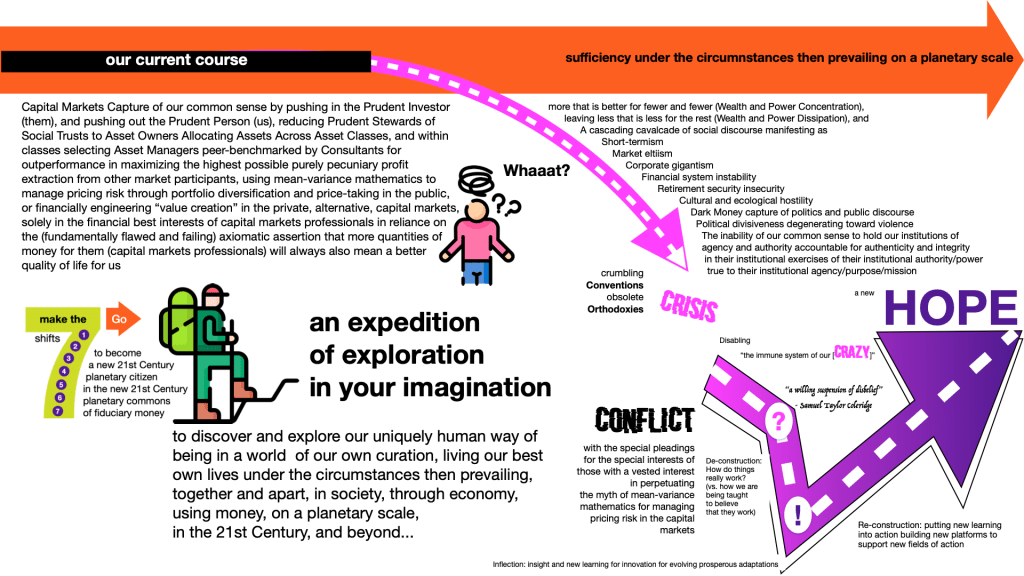
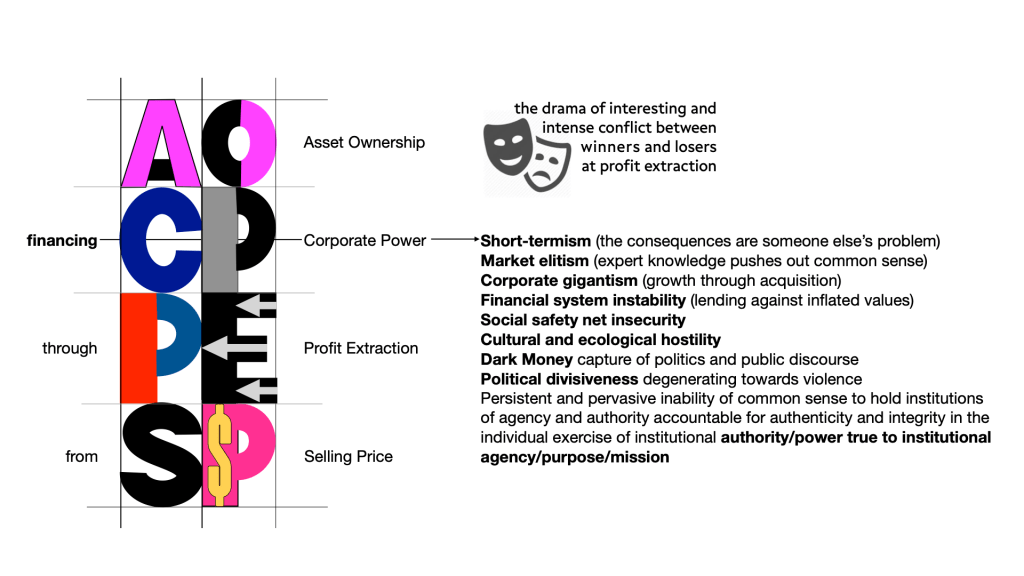
misconnected to the expert knowledge of experts in outperformance at maximizing the highest possible purely pecuniary profit extraction from volatility and growth in market clearing prices for securities in the markets for maintaining volatility and growth in market clearing prices for those securities, solely in the financial best interests of securities trading markets professionals, in reliance on the false and failing assertion that more money in the securities trading markets (and more fees and profits for Asset Managers, Consultants, Corporate Executives and other securities trading markets professionals) will also always mean a better quality of life for all of us.
Fiduciary Stewards charged with financing a Dignified Future through their prudent exercise of capacity derived from character true to aims,
have become
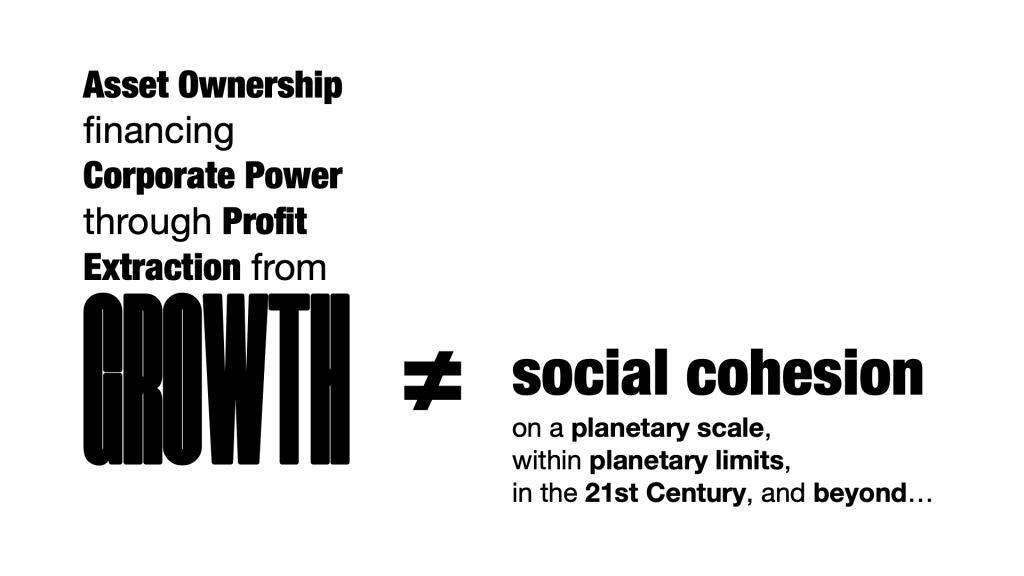
Asset Owners financing Corporate Power through Profit Extraction from Growth in Selling Price, powering a cascading cavalcade of social reactions that are powering social discord.
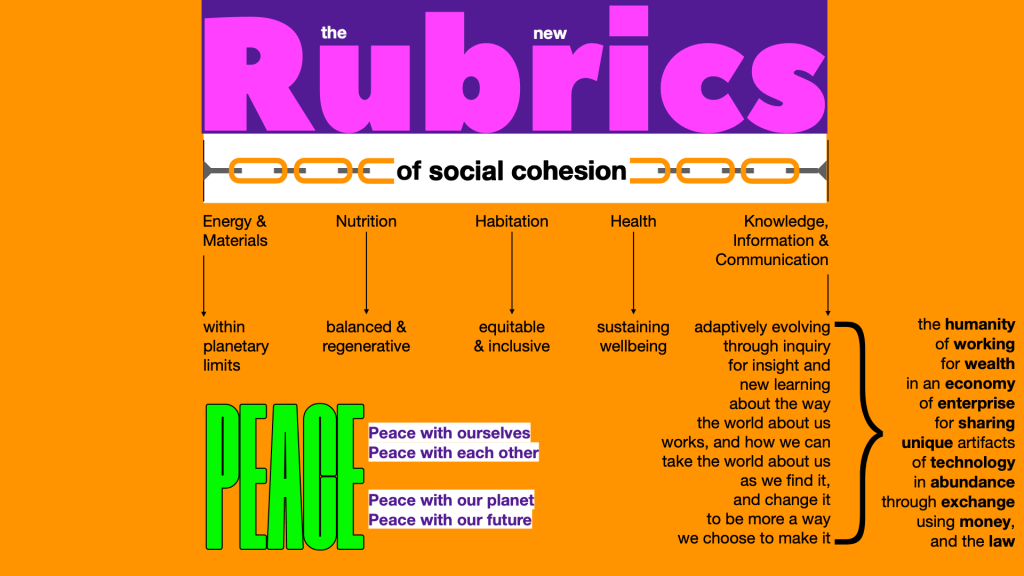
To ease this polycrisis of social discord, we have to disconnect Fiduciary Money from Growth as a false proxy for the right economy, and re-connect it to Social Cohesion, as the right rubric for the right economy.
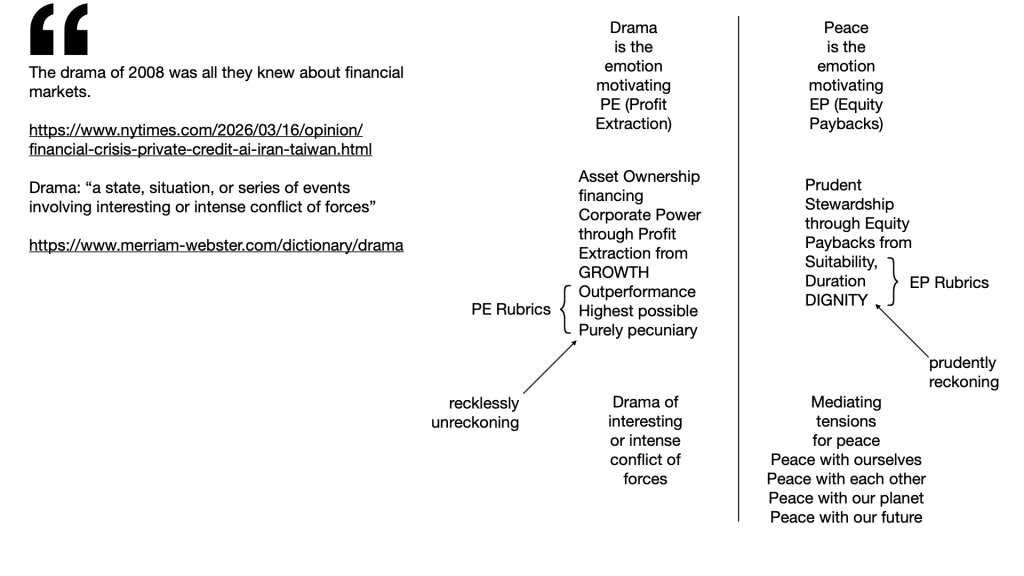
We can do that by shifting fiduciary capacity from Asset Ownership to Equity Paybacks.
The shift from Asset Ownership to Equity Paybacks in Fiduciary Finance is a very small, very technical upgrade in the mathematics used by the fiduciary stewards of Pensions & Endowments to calculate the cost of money charged to enterprise:
from securities trading for profit extraction from growth in selling price
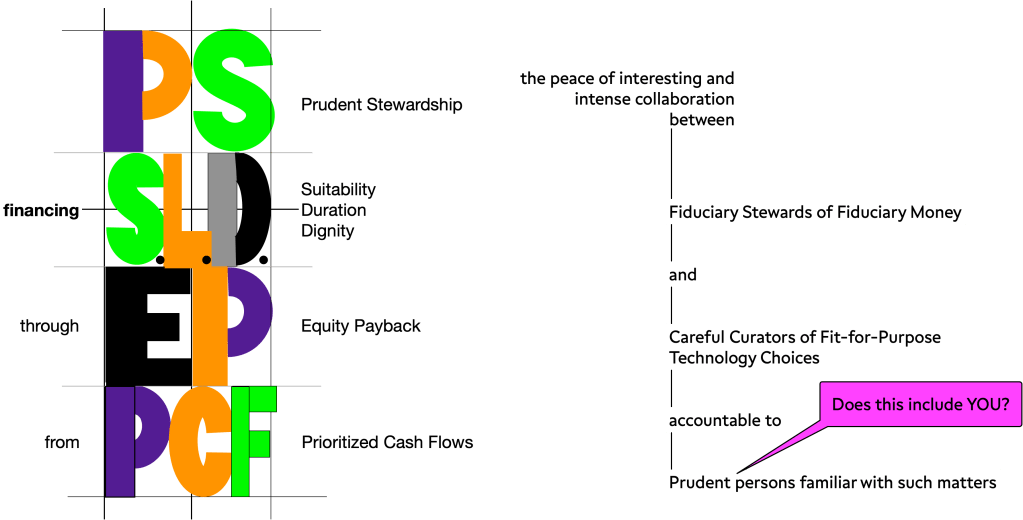
to equity paybacks from current cash flows through enterprise that are prioritized by contract for Suitability, Duration and Dignity.
But before fiduciary stewards can make that technical upgrade, we need to first unshackle our common sense of the economy from the locked imaginary that Growth, as the simple quantitative increase in qualitatively undifferentiated transaction volumes, measured in numbers, as prices paid in money, from one period of measurement to the next, is both necessary and sufficient to our being and our well-being as humans living together in society, through economy.
We need to expand beyond this reductionist story of the economy as the production and distribution of goods and services for allocating scarcity through price in perfectly free markets, that calls upon each of us and all of us to work hard to produce and consume more, so that the [free] markets can give us more, on the promise that more will always be better, and that we will each always be perfectly free to determine, each for ourselves, what more is better for us.
The lynchpin proposition in this social narrative of the economy is the assertion that more = better.
Common sense of shared lived experience tells us that sometimes more is better. Other times, it is not.
more = better, sometimes
It depends.
More of what?
Better for who?
If more is not always better, then Growth is not really the North Star guiding us to the right economy.
It’s more complicated, and less calculated, than that.
The bigger truth is that the economy is not numerical.
It is human.
And complex.
A whole made up of parts, each with its own subparts.
unboxing
.
Working for Wealth
the Promethean gift of fire
Technology
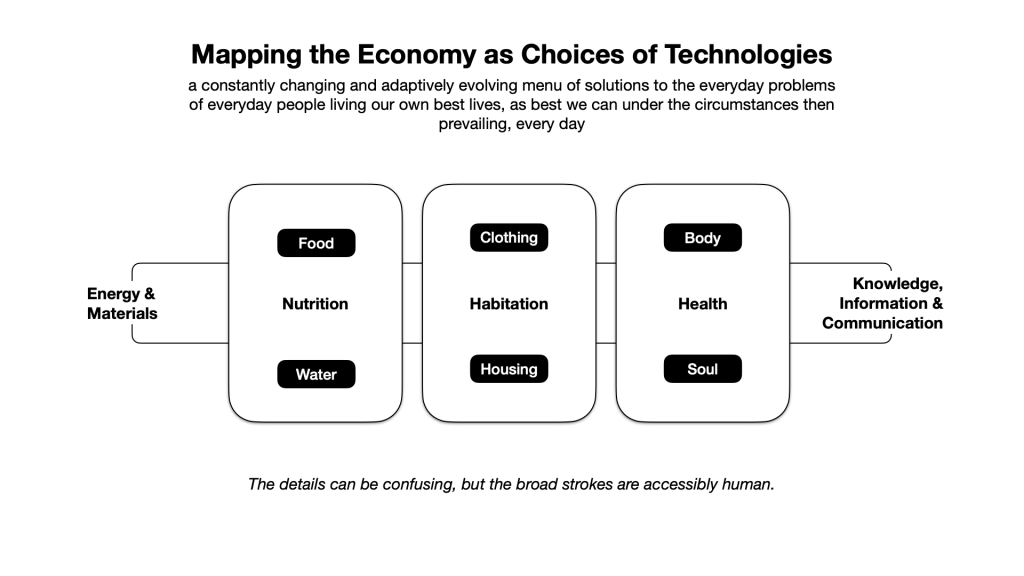
knowledge of how the world about us works in some particular and specific way, and we can do the work of taking the world about us as we find it, in that particular and specific way, and change it to be more a way we choose to make in that particular and specific way, creating choices for humans out the laws of Nature, as solutions to the everyday problems of everyday people living our own best lives, as best we can, under the circumstances then prevailing, every day
the Biblical curse of toil
Enterprise
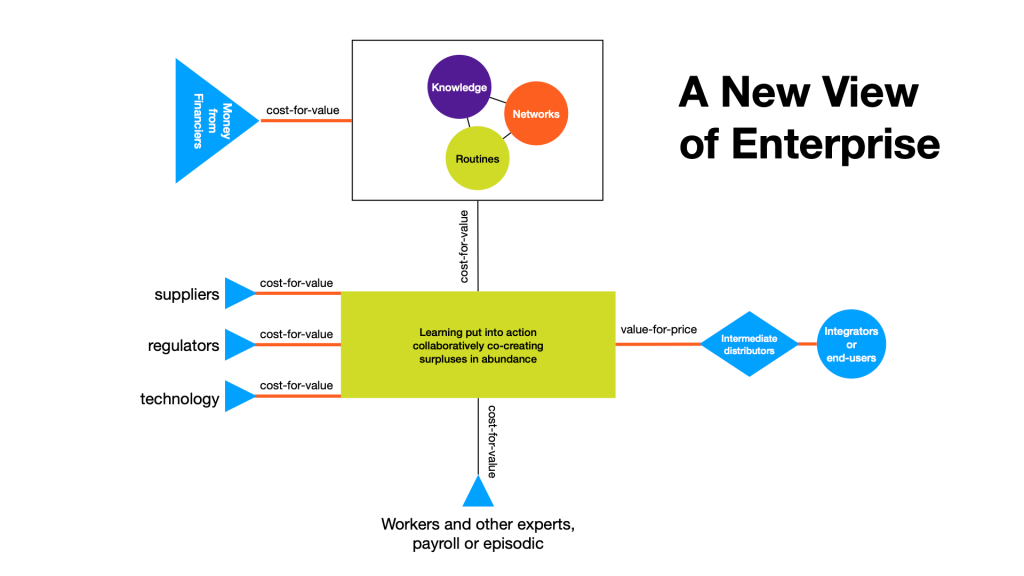
the social organization of physical Knowledge + Networks + Routines for concentrating the time, effort and expertise of people creating through curation an abundance of unique artifacts of Technology in surplus for sharing with others in exchange for a price, as a social reactor for transforming cost-for-value into value-for-price
Financing Enterprise
Every business needs money as capital, to pay cost-for-value to create through curation an abundance of unique artifacts of the concentration of time, effort and expertise to apply technology to supply choices to others, in surplus for sharing with others through the exchange of value-for-price.
“Capital is just savings”
Peter Ellis, The Accidental Societist
When business needs money, Finance provides it.
Finance
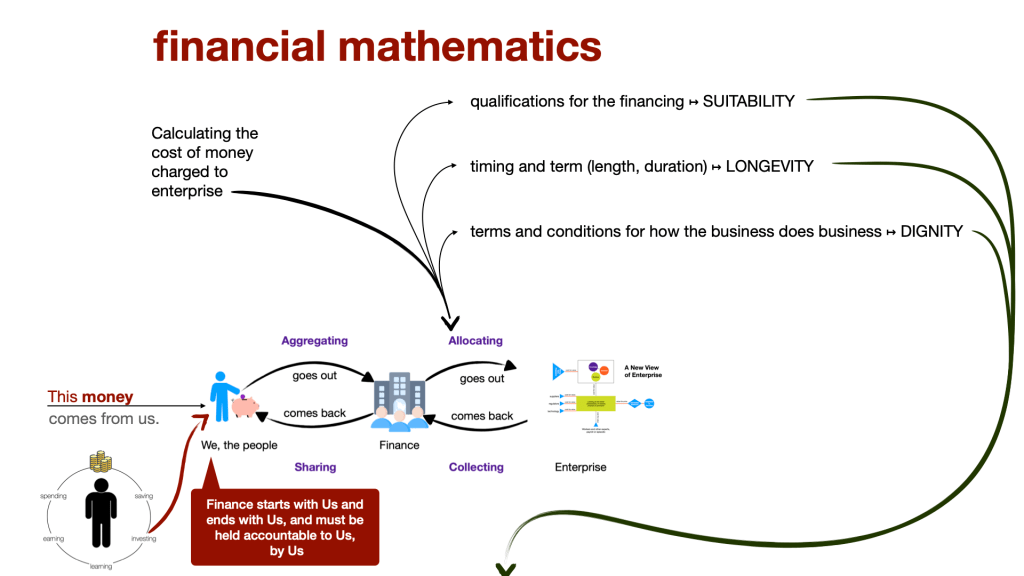
aggregates money that is set aside by others, for a future purpose, for a future time, and
allocates those aggregations as money made to flow into enterprise, as capital for business.
Finance has to finance something.
What Finance finances is determined by the mathematics used to calculate the cost that is charged to Enterprise for its use of money as capital in business.
This mathematics of allocation also determines:
the qualifications that must be met to obtain the use of money (demonstrated ability to pay the cost that will be charged):
the time and timing of the permitted use of that money; and
the terms that specify how the business must do business that must be honored by the enterprise to continue the agreement that permits the use of the money.
This is how Finance curates the economy.
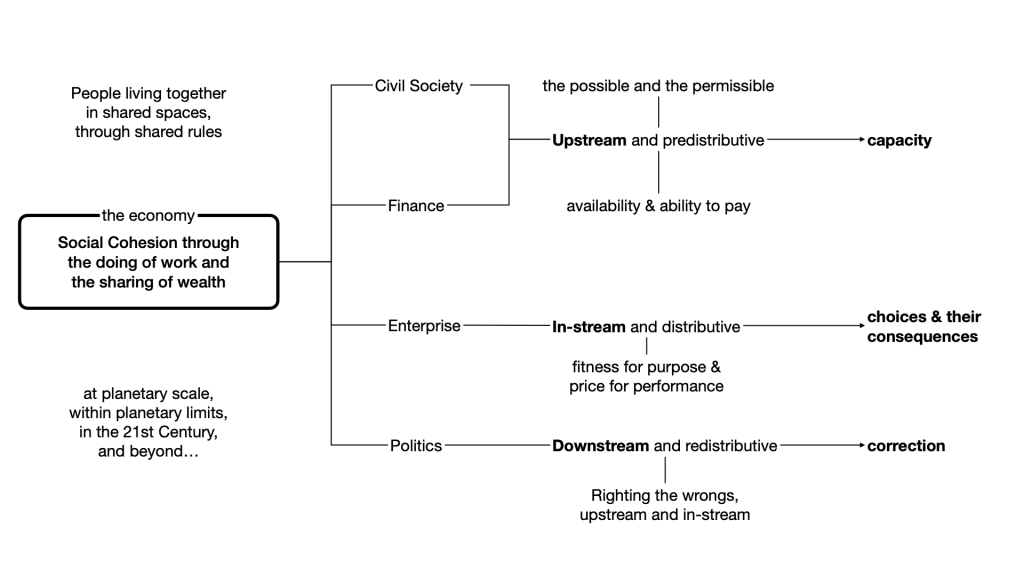
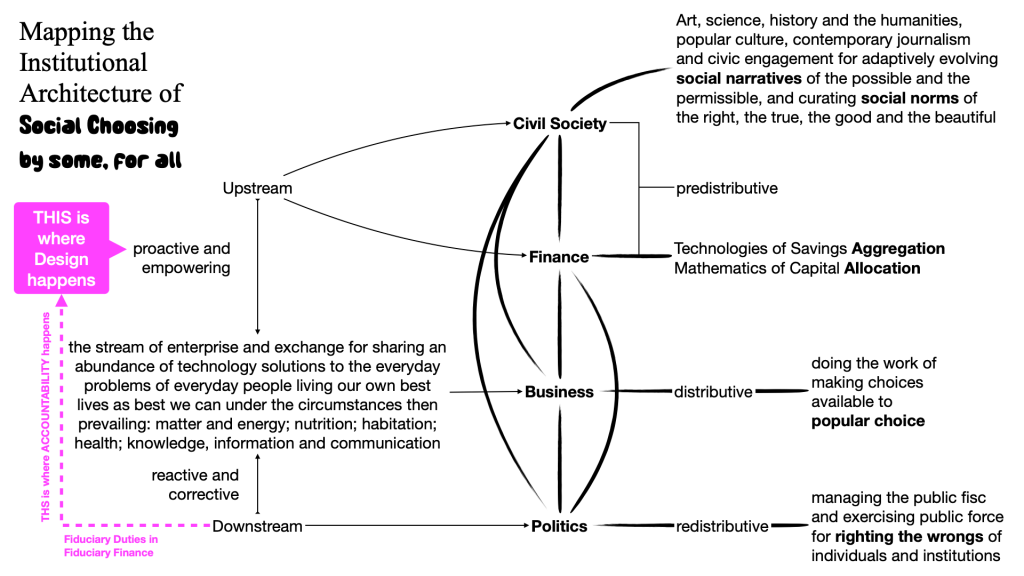
It is through the technologies for aggregating savings and the mathematics for allocating those aggregations that populations decide which enterprises will be endowed with capital as the capacity to do business, and the terms on which the business must do business in order to continue in business, with the capital they need to do business.
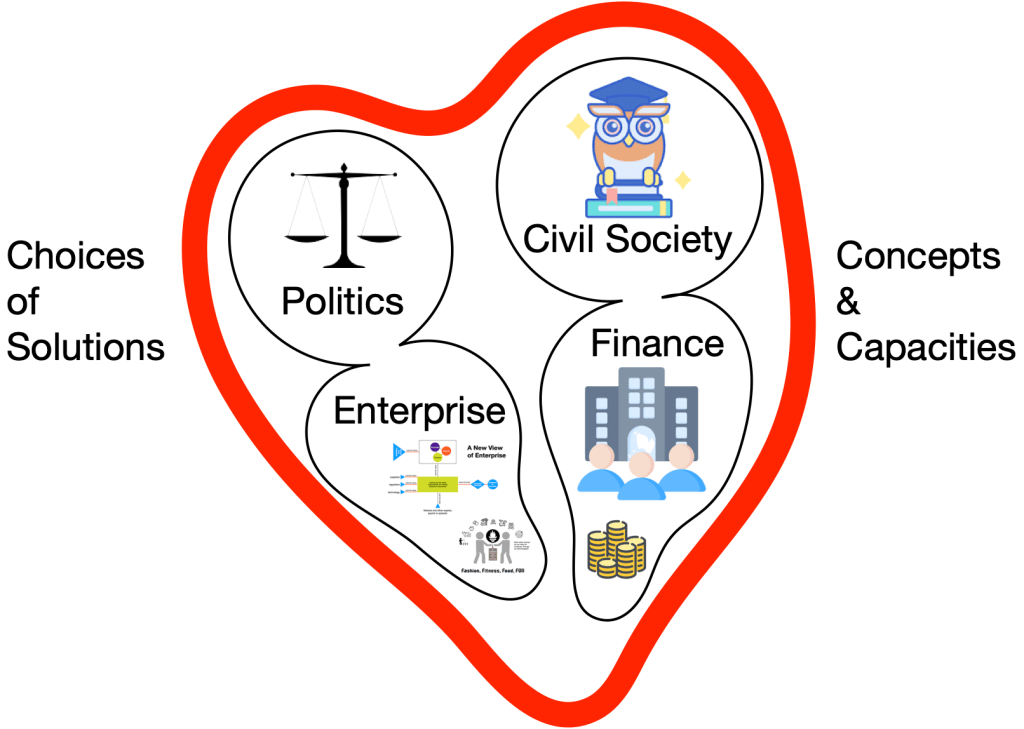
Through institutions of Civil Society – schools and universities, libraries and museums, cultural centers, cultural centers, publishing, broadcasting and now social media, journalism and the arts for creating “social objects around which conversations can happen” (Gaping Void Cultural Design Group) – a population adaptively its social narratives of the possible and the permissible, and curate social norms of the right, the true, the good and the beautiful.
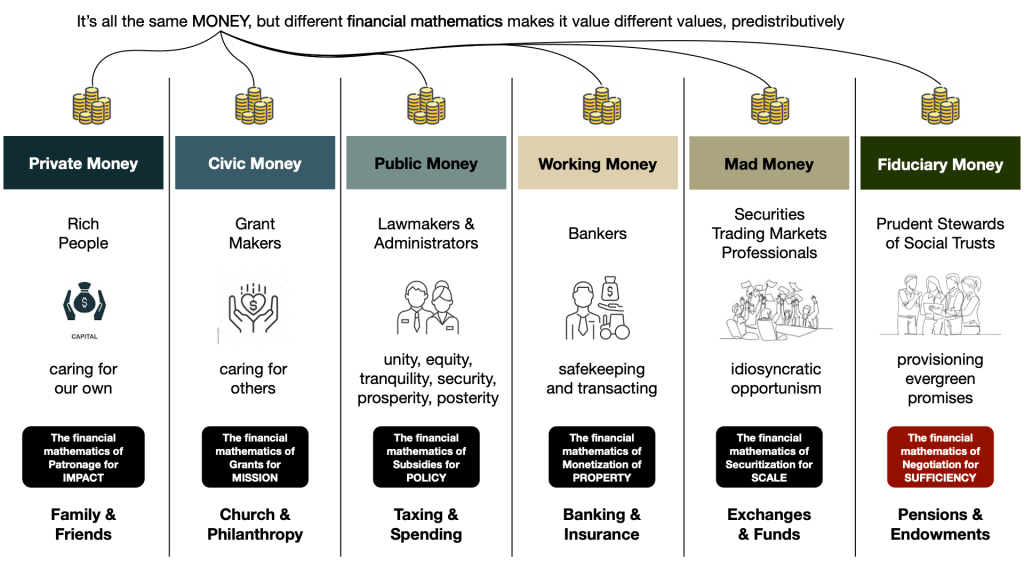
Through institutions of Finance – Personal Wealth (Friends & Family), Foundations (Church & Philanthropy), the Public Fisc (Taxing & Spending), Banking & Insurance, Securities Trading Markets (Exchanges & Funds, and Social Trusts (Pensions & Endowments) – a population curates which technology choices will be made available to popular choice, and who will have the ability to pay the price of making those choices (institutional determination of availability and ability to pay).
Through institutions of Enterprise – sole proprietorships, general partnerships, limited partnerships, limited liability companies, cooperatives, mutual companies, general purpose and special purpose corporations and other legal forms of business ownership for investment and control – a population self-organizes the work of making technology choices available to popular choice, through individual determinations of fitness for purpose and price for performance.
This gives the lie to the currently customary mythology of “free” markets, and its corollary, the money is a measure of morality. Yes, we are each personally free to determine, each for ourselves, from among the choices available to us, which choices we will choose, based on our our personal and idiosyncratic determinations of fitness and price, but those determinations are made within the institutionally determined constraints of what is actually made available to us, from which to choose, and of how much of what is available we can actually afford.
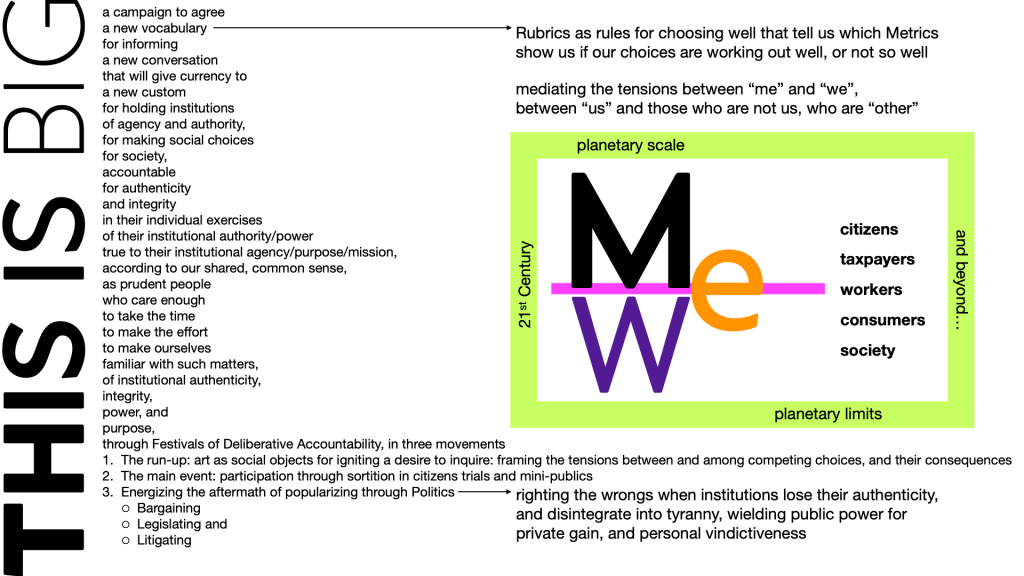
Through institutions of Politics (and Policy) – governmental agencies and authorities from the general to the specialized, at local, regional, national, international, multi-national and global levels – populations manage the public fisc (Taxing and Spending) and exercise public force (law and regulation) to “right the wrongs” when individual and institutional actions stray too far away from social norms and lawful purpose.
The Institutional Heart of Being Human in Society, through Economy
Designing the world we want
Democracy in Fiduciary Finance, Upgraded
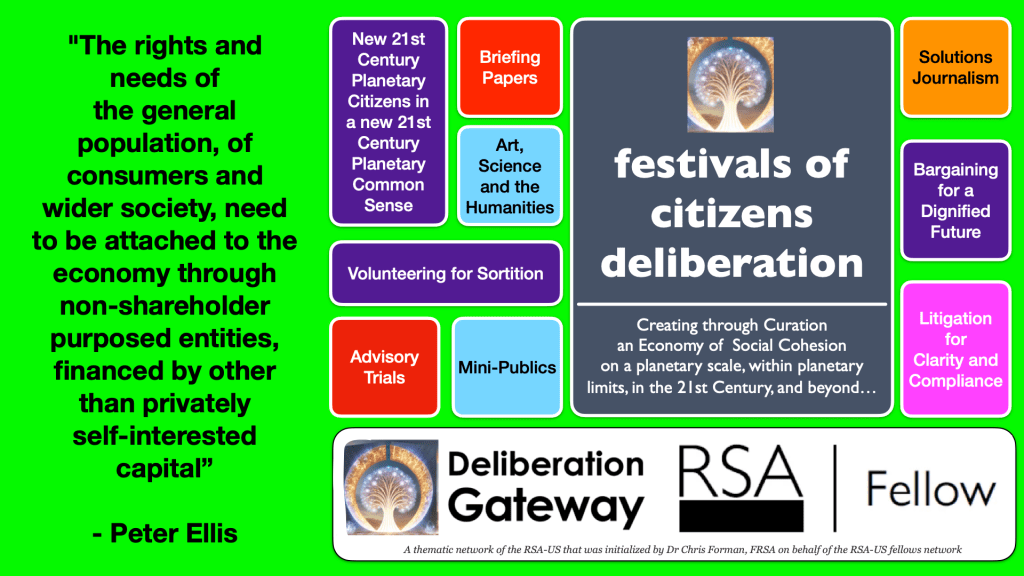
A rectification through deliberation, to re-assert our common sense of what makes sense in enterprise, finance, the economy and society
           “
 what kind of world
             do we want
      and how
               can we make it happen?
Simon Mair, MEND Network
THIS is the world we want
THIS is how we can make it happen
allocating Fiduciary Money through Equity Paybacks from current cash flows through Enterprise, prioritized by contract for:
Suitability of the Technology to the circumstances prevailing at the time;
Duration of the social contract between Enterprise and popular choice over time; and
Dignity in how the business does business all the time, across all six vectors of cash flow through Enterprise, including:
Fair Trade, with suppliers;
Fair Engagement with communities, of place and of interest;
Fair Reckoning with the consequences, on Nature, Society and the Future;
Fair Working, in the workplace;
Fair Dealing, in the marketplace;
Fair Sharing, with savers whose savings are the “raw material” form which financiers fashion capital for business.













 Shifting to Equity Paybacks