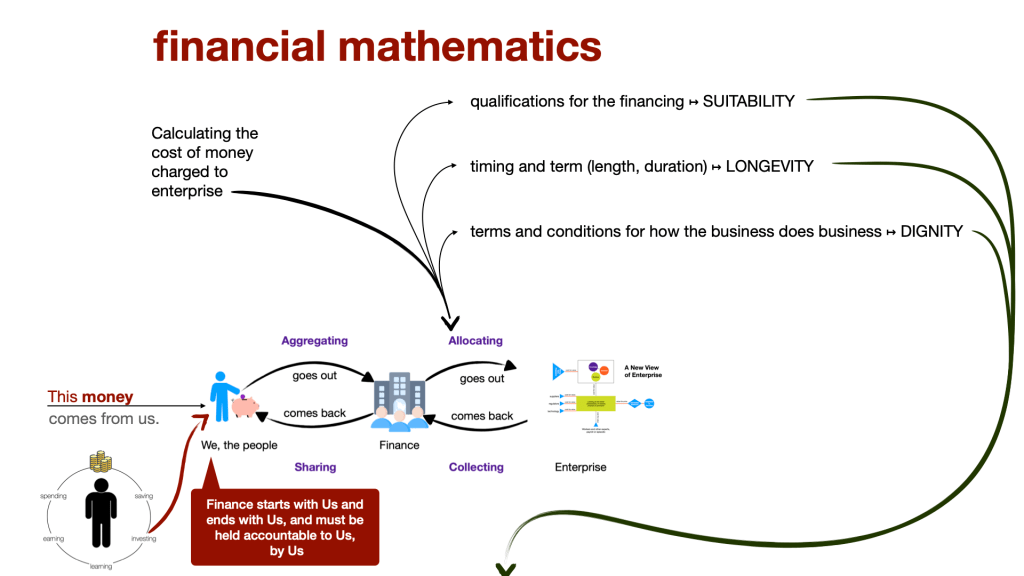
Financing is an agreement between a financier and an enterprise or individual, for the use of money for a purpose, for a time, at a cost, and on terms that must be honored to keep the financing in place, according to the agreement.
Each agreement for calculating the cost that is agreed for the use of the money determines:
- which individuals or enterprises qualify for the financing, based on their demonstrated ability to pay the cost, as agreed;
- the purpose(s) for which the money can be used
- the time and timing of the use of that money and
- the conditions that most be honored by the individual or enterprise accepting the financing, relative to how that individual or enterprise acts with respect to the money and its permitted use(s), in order to continue that permitted us, as originally agreed (failure to meet thesis agrees conditions can result in termination of the agreement).
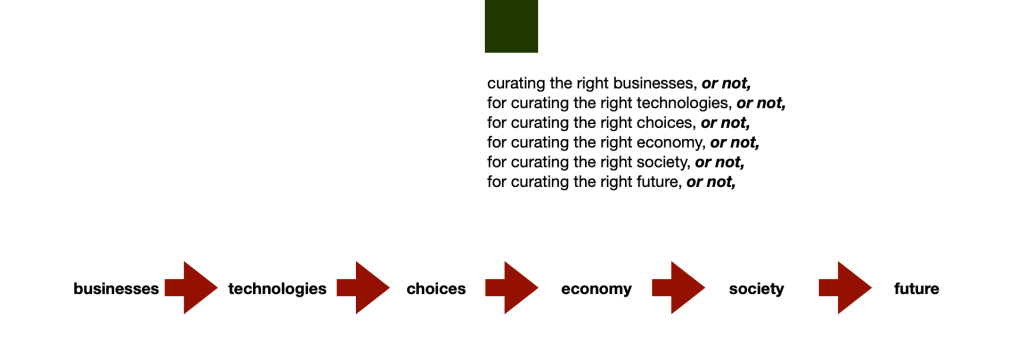
In the specify case of financing for enterprise, this configuration of qualifications, duration and conditions empowers and constrains how that business will do its business of applying technology to make choices available in the economy, for social cohesion, through suitability, duration and dignity ongoing into a secure future, or social discord through corruption of the code of accountability, of institutions, to their purpose.
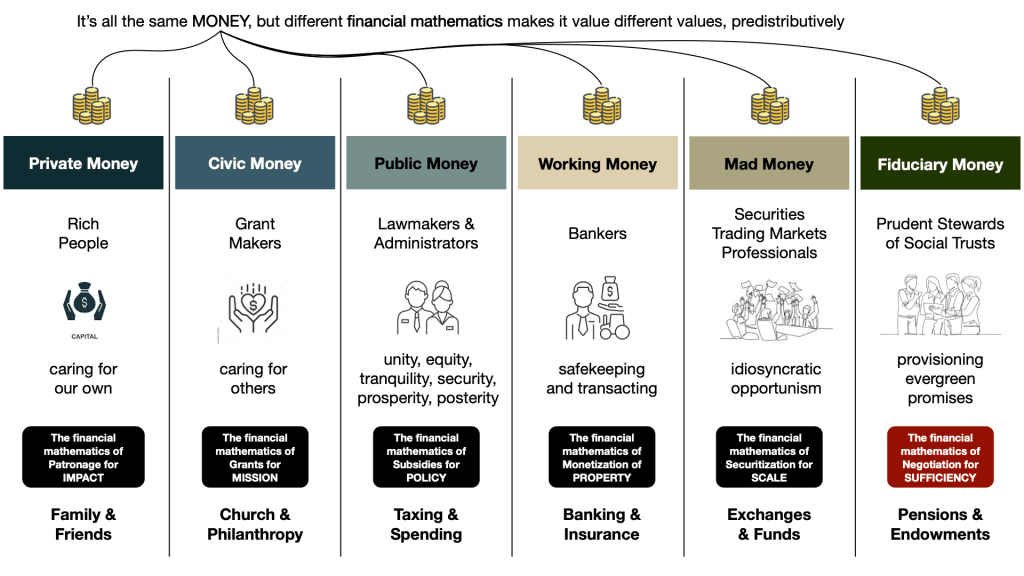
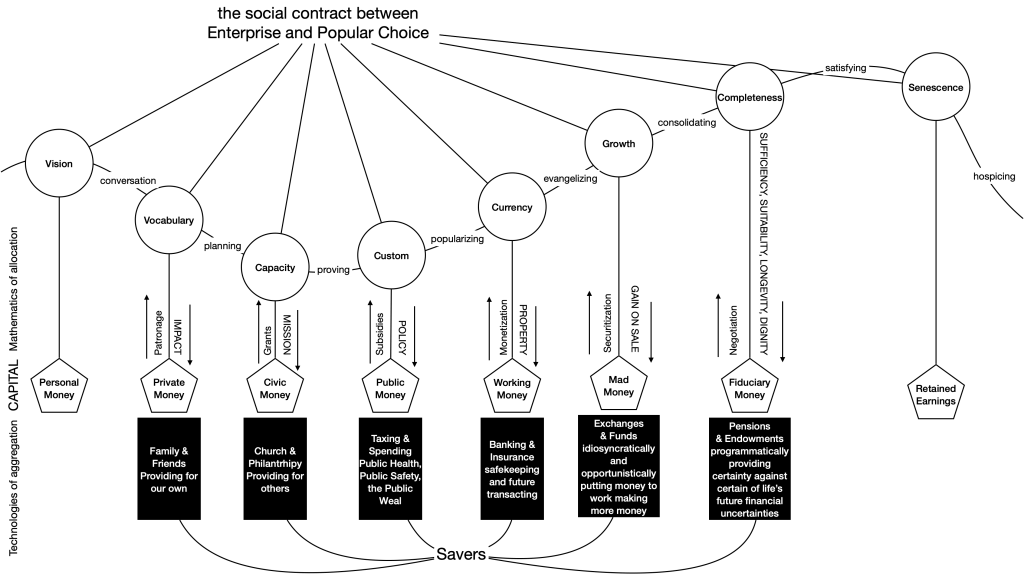
Under the circumstances now prevailing, there are six different mathematics of allocation in finance:
- patronage
- grants
- subsidies
- monetizaton
- extraction
- stewardship.
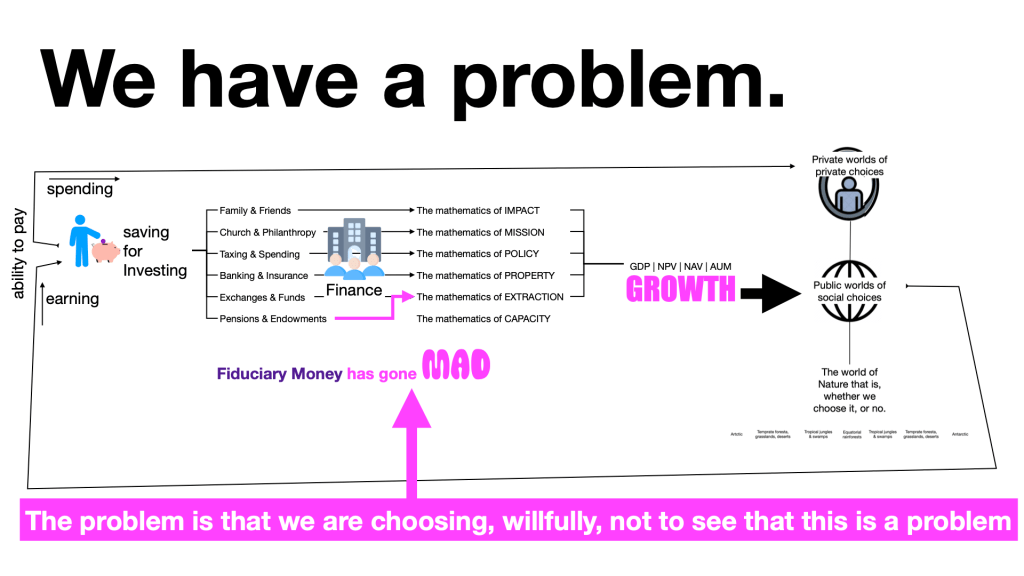
Except today we do have this problem. Stewardship is being channeled into Extraction.
Fiduciary steward of income security in a dignified future for so many, directly, as a private benefit, that it is also, of necessity, for us all, consequently, as a public good, is being remade – by lore, in violation of the law – as:
- Asset Owners Allocating Asset Across Asset Classes (Assets = specified securities traded in specified securities trading markets)
- and within classes mandating/selecting Asset Managers (mostly using the financial mathematics of equity paybacks to finance the execution of specified strategies for trading specified securities in specified securities trading markets)
- who are benchmarked by Consultants against their peers (other Asset Managers expert in profit extraction from securities)
- for outperformance in maximizing the highest possible purely pecuniary profit extraction from volatility and growth in market clearing prices for securities in the markets for maintaining volatility and growth in market clearing prices for those and other similar securities
- solely in the financial best interests of Asset Managers, Consultants, Corporate Executives and other securities trading markets professionals
- in reliance on the axiomatic assertion that more money in the securities trading markets (higher fees and profits for Asset Managers, Consultants, Corporate Executives and other securities trading markets professionals) will also always mean a better quality of life for alll
This is obviously the special pleading for the self-interest of securities trading markets professionals, in bringing the tens of trillions in society’s “safe” money aggregated into social trusts for provisioning the mutual aid societies of Workforce Pensions and Civil Society Endowments, as “forever machines”, to assure income security in a dignified future for some, directly, and all, consequently.
That is a problem.
Because the self-interest of securities trading markets professionals in extracting fees and profits from fiduciary money is not aligned with either the purpose of Pensions & Endowments or the purpose of securities trading, but is, in fact, a corruption of the code of both fiduciary duty and the mathematics of securities trading.
And that corruption is spreading into Enterprise (the social responsibility of business is not, as Milton Friedman declared in his self-proclaimed Friedman Doctrine, to grow is profits: the role of business in society in more nuanced and human than that reductionist philosophy), and through Enterprise into both Civil Society and Politics, causing all four of our institutions of social choosing to break faith with their institutional agency/purpose/mission in the exercise of their institutional authority/power.
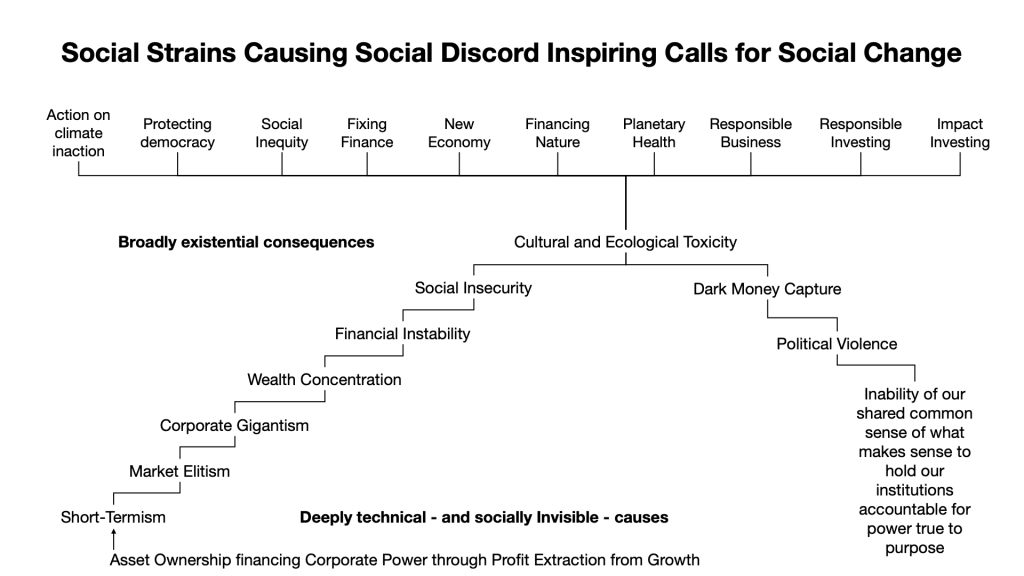
This pervasive and persistent failure of institutional power true to purpose is eroding the trust that is essential to social cohesion, and straining many of the stress points in the networks of connections that is the economy and society to, and sometimes past, their breaking points.
We can see these strains being acknowledged across a multiverse of social change advocacy campaigns that spans:
- Action on climate inaction
- Protecting democracy against rising populism/autocracy
- Social Inequity across multiple vectors: wealth inequality, colonialism, racism, and such
- Fixing Finance (through multiple theories of change, such as corporate social responsibility, responsible investing, sustainability, ESG [Environment, Social and Governance], DEI [Diversity, Equity and Inclusion], the SDGs [Sustainable Development Goals], shareholder activism, Impact investing, Blending Finance, and System Level Investing/Universal Ownership)
- New Economy
- Financing Nature
- Planetary Health
- Responsible Business
- Responsible Investing
- Impact Investing
What is missing is an appreciation for how all of these stress emanated from the same, single source: Asset Owners financing Corporate Power through Profit Extraction from Growth.
And that;s the problem Citizens Deliberation on Equity Paybacks can solve.



 Shifting to Equity Paybacks